Lower back stretches can help you explore comfortable spinal and hip movement when your back feels stiff, particularly after prolonged sitting, inactivity or training.
But there is no single “best” lower back stretch for everyone.
Low-back symptoms can respond differently to bending forward, extending backward, rotating or stretching the hips. The goal is not to force more flexibility. It is to find movements that feel comfortable, maintain normal activity and do not cause symptoms to spread into the leg.
For persistent low-back pain, stretching is usually more useful as one part of a broader exercise program that may also include strengthening, walking, aerobic exercise and movement-control work.
8 Lower Back Stretches and Mobility Exercises
| Exercise | Primary Movement or Target |
|---|---|
| Cat-Cow | Gentle spinal flexion and extension |
| Single knee-to-chest | Comfortable lumbar/hip flexion |
| Pelvic tilt | Pelvic and lumbar control |
| Child’s Pose | Flexion and relaxed spinal/hip position |
| Supine spinal twist | Gentle trunk rotation |
| Sphinx pose | Supported lumbar extension |
| Figure-four stretch | Glutes and deep hip rotators |
| Quadratus lumborum stretch | Side of lower back and trunk |
You do not need to perform all eight.
Choose movements based on comfort and how your symptoms respond.
1. Cat-Cow Stretch
Cat-Cow moves the spine gradually between flexion and extension.
It can be useful when the main goal is simply to get the back moving rather than holding a long static stretch.
How to do it
- Begin on your hands and knees.
- Slowly round your back upward.
- Reverse the movement and gently allow your spine to arch.
- Keep both directions within a comfortable range.
- Repeat slowly.
Avoid forcing either end position.
See the Cat-Cow Stretch guide for detailed technique.
2. Single Knee-to-Chest Stretch
The knee-to-chest position moves the hip and lower back toward flexion.
How to do it
- Lie on your back with your knees bent.
- Bring one knee slowly toward your torso.
- Hold behind the thigh or over the shin.
- Keep the other leg comfortable.
- Return slowly and change sides.
If a double-knee position feels comfortable, you can bring both knees toward your chest.
The movement should not increase radiating leg symptoms.
See Knees to Chest Stretch for a complete walkthrough.
3. Pelvic Tilt
Pelvic tilts are more about controlled movement than deep stretching.
They can help you explore the relationship between your pelvis and lumbar spine.
How to do it
- Lie on your back with your knees bent and feet on the floor.
- Gently change the position of your pelvis so your lower back moves slightly toward the floor.
- Relax back toward neutral.
- Repeat slowly.
The movement is small.
Do not force your back flat against the floor.
See the Pelvic Tilt Stretch for detailed form.
4. Child’s Pose
Child’s Pose places the hips and spine into a flexed position.
Some people find it relaxing after sitting or exercise.
How to do it
- Begin on your hands and knees.
- Move your hips gradually toward your heels.
- Reach your arms forward or keep them closer to your body.
- Stop at a comfortable position.
- Breathe normally.
Your hips do not need to reach your heels.
If the position worsens back or leg symptoms, choose another movement.
See the Child’s Pose Stretch for modifications.
5. Supine Spinal Twist
A supine twist introduces gentle trunk rotation.
How to do it
- Lie on your back.
- Bend your knees.
- Allow your knees to move slowly toward one side.
- Keep the range comfortable.
- Return to center before switching sides.
The goal is easy rotational movement—not pushing your knees toward the floor.
For detailed technique, see the Supine Spinal Twist.
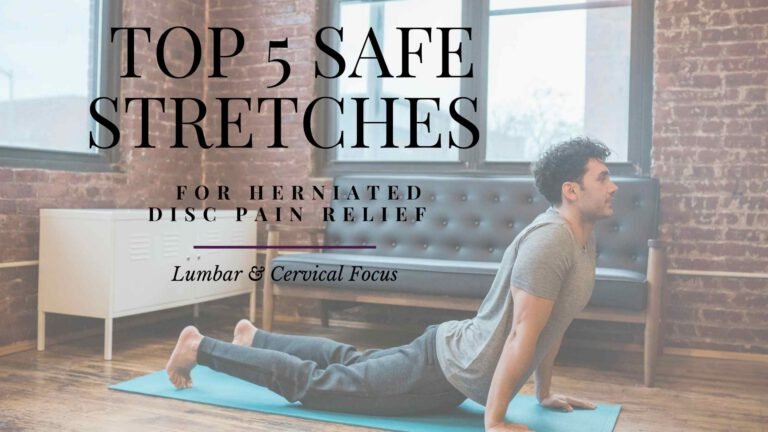
6. Sphinx Pose
Sphinx Pose moves the lumbar spine in the opposite direction from knee-to-chest or Child’s Pose.
It introduces gentle extension.
How to do it
- Lie on your stomach.
- Place your forearms beneath or slightly forward of your shoulders.
- Lift your upper chest while keeping the pelvis supported.
- Stop at a comfortable height.
- Relax back down.
Some people tolerate extension well; others do not.
Pay attention to what happens to your symptoms rather than assuming extension is automatically good or bad.
See the Sphinx Pose Stretch for detailed positioning.
7. Figure-Four Stretch
Not every sensation of lower-back tightness originates in the lumbar spine.
Hip and glute stiffness can accompany back discomfort, which makes a hip-focused stretch useful in some routines.
How to do it
- Lie on your back with both knees bent.
- Cross one ankle over the opposite thigh.
- Stay there or gently bring the supporting leg toward you.
- Stop when you feel a comfortable stretch through the glute or outer hip.
- Repeat on the other side.
This should feel primarily muscular.
If it produces shooting, burning or electrical sensations down the leg, stop.
See the Lying Figure Four Stretch for detailed technique.
8. Quadratus Lumborum Stretch
The quadratus lumborum, or QL, is a muscle along the side of the lower trunk.
A gentle side-bending movement can target this region.
How to do it
- Sit or stand upright.
- Reach one arm overhead.
- Bend gently toward the opposite side.
- Keep your torso from aggressively twisting.
- Return slowly and repeat if comfortable.
The stretch should feel mild along the side of the trunk or lower back.
See the Quadratus Lumborum Stretch for variations.
Different Lower Back Stretches Move the Spine in Different Directions
This is one of the most important things to understand about lower-back stretching.
A routine can include:
Flexion
- knee-to-chest
- Child’s Pose
- the rounded phase of Cat-Cow
Extension
- Sphinx Pose
- prone press-up
- standing back extension
- the arched phase of Cat-Cow
Rotation
- supine spinal twist
- lumbar rotation
Side bending
- quadratus lumborum stretch
- standing side bend
Hip mobility
- figure-four stretches
- hip-flexor stretches
- hamstring mobility when appropriate
One direction is not universally superior.
Your response matters more than collecting as many stretches as possible.
A Simple Lower Back Mobility Routine
For uncomplicated stiffness, a short sequence could include:
- Cat-Cow — several slow repetitions
- Pelvic tilts — several controlled repetitions
- Single knee-to-chest — each side
- Figure-four stretch — each side
- Sphinx Pose — only if comfortable
- Short walk
You do not need to force long holds.
A routine that feels easy enough to repeat consistently is often more practical than an aggressive session that leaves you more irritated afterward.
What Should a Lower Back Stretch Feel Like?
A comfortable stretch may create:
- mild pulling
- a sense of stiffness changing
- gentle muscular tension
- easier movement afterward
Stop or modify the movement if it causes:
- sharp pain
- strong pinching
- burning
- electrical sensations
- increasing numbness
- increasing tingling
- weakness
- symptoms traveling farther down a leg
Low-back pain with neurological leg symptoms requires a different level of caution than ordinary stiffness.
Stretching for Lower Back Pain vs Lower Back Stiffness
These are related searches, but they are not identical problems.
A back that feels stiff after sitting may respond well to simply changing position, walking and performing gentle mobility.
Pain can have many contributors and does not always mean a muscle needs to be stretched.
For persistent pain, exercise programs are generally more evidence-supported than relying on stretching alone.
That can include:
- strengthening
- aerobic activity
- walking
- mobility
- movement-control exercises
- mind-body exercise
- general physical activity
Stretching can fit inside that larger approach.
Should You Stretch During Acute Lower Back Pain?
Gentle movement may be appropriate for many episodes of uncomplicated low-back pain, but aggressively stretching a painful back is unnecessary.
Clinical guidance generally encourages people to remain active within their abilities rather than using prolonged bed rest.
During a flare:
- keep movements comfortable
- avoid forcing painful ranges
- continue ordinary activity as tolerated
- change positions regularly
- consider short walks
- seek evaluation if symptoms are severe or concerning
The goal is not to “stretch the pain away.”
Should You Rest a Sore Lower Back?
Prolonged inactivity is generally not the preferred strategy for uncomplicated low-back pain.
Guidelines encourage continuing normal activity when possible.
That does not mean ignoring pain or forcing exercise.
It means modifying activity rather than automatically avoiding movement altogether.
A short walk can sometimes be a better starting point than an intensive stretching session.
Stretching vs Strengthening for Lower Back Pain
For recurring or persistent low-back pain, strengthening deserves as much attention as flexibility.
Clinical exercise programs may include:
- trunk strengthening
- muscular endurance
- specific trunk-muscle activation
- movement-control training
- aerobic exercise
- general exercise
Research does not clearly identify one exercise type as universally best.
That is important because a persistent low-back problem should not automatically be interpreted as “tight muscles.”
Flexibility is only one part of physical capacity.
Are Tight Hamstrings Causing Your Lower Back Pain?
Not necessarily.
Hamstring flexibility can affect some movement patterns, but lower-back pain is rarely explained by one tight muscle alone.
Stretching your hamstrings may be reasonable when they feel restricted and the movement is comfortable.
But if straightening the leg produces:
- shooting pain
- tingling
- burning
- numbness
you may be tensioning irritated neural tissue rather than simply stretching muscle.
If symptoms travel into the leg, use the Sciatic Nerve Stretches guide instead of automatically increasing hamstring stretch intensity.
Can Tight Hips Affect How Your Lower Back Feels?
Hip stiffness can change how you move during activities such as squatting, walking, sitting and bending.
That makes hip mobility a useful supporting area to consider.
Relevant FlexologyGuide resources include:
However, improving hip flexibility is not guaranteed to eliminate back pain.
The relationship is more complex than one “tight” body part causing another to hurt.
Lower Back Pain With Sciatica
Sciatica usually involves pain or neurological symptoms traveling from the lower back or buttock into the leg.
That is different from ordinary local back stiffness.
Symptoms may include:
- radiating leg pain
- numbness
- tingling
- weakness
If these symptoms are present, avoid assuming that the answer is deeper lower-back or hamstring stretching.
Use the Sciatic Nerve Stretches guide for more specific education.
Lower Back Pain and Herniated Discs
A lumbar disc herniation is one possible source of back or leg symptoms.
It is not the cause of every episode of low-back pain.
Because people with disc-related symptoms can respond differently to spinal movements, generic stretch recommendations may not be appropriate for everyone.
See Herniated Disc Stretches for more specific guidance.
Lower Back Pain and the SI Joint
Pain around the low back, pelvis or buttock can sometimes be attributed to the sacroiliac region.
SI-joint symptoms should not automatically be treated as lumbar muscle tightness.
The SI Joint Stretches guide covers that topic separately.
What About Lower Back Pain From Sitting?
Sitting itself is not inherently dangerous.
But staying in the same position for a long time can contribute to discomfort or stiffness in some people.
A practical approach is to vary your position.
Try:
- standing periodically
- short walks
- gentle spinal motion
- hip movement
- changing chair position
- alternating tasks when possible
There is no single perfect sitting posture that must be maintained all day.
Movement variety is usually more practical.
Lower Back Stretches After a Workout
After training, gentle static stretches can be used if they feel good.
You may choose movements for the:
- hips
- glutes
- hamstrings
- trunk
- lower back
However, stretching is not required for recovery, and it does not replace hydration, sleep, appropriate training load or general recovery.
Use a calm range rather than forcing flexibility when tissues are already fatigued.
Lower Back Stretches in the Morning
Some people feel stiff after sleeping.
Instead of immediately moving into a deep forward bend or twist, begin with easy movement.
Options include:
- walking around for a few minutes
- pelvic tilts
- gentle Cat-Cow
- comfortable rotation
- hip movement
Increase range gradually as your body warms up.
For a full-body option, see the Morning Stretch Routine.
How Often Should You Stretch Your Lower Back?
There is no universal schedule.
Frequency depends on:
- your goal
- your symptoms
- the movement being performed
- how you respond
- whether you are following a rehabilitation program
Gentle mobility can be performed regularly if it feels comfortable.
But more stretching is not automatically better.
If a stretch repeatedly aggravates symptoms, repeating it more often is unlikely to solve the problem.
Do You Need to Hold Lower Back Stretches for 30 Seconds?
No single holding time applies to every lower-back mobility exercise.
Static muscle stretches are often held briefly, but exercises such as Cat-Cow, pelvic tilts and repeated extension are movement-based rather than long static holds.
That is why a routine should distinguish between:
- static stretching
- controlled mobility
- repeated movement
- strengthening
They serve different purposes.
Can Assisted Stretching Help Lower Back Tightness?
Assisted stretching may be useful for general hip and trunk flexibility when performed appropriately.
But a stretch professional should not diagnose the cause of unexplained back pain unless they are properly licensed to do so.
People with:
- significant neurological symptoms
- severe unexplained pain
- recent trauma
- progressive weakness
- bowel or bladder changes
need appropriate medical evaluation rather than aggressive assisted stretching.
For an overview of the service, see What Is Assisted Stretching?.
FlexologyGuide also has a dedicated guide to Assisted Stretching for Back Pain for readers considering professional stretching.
When to See a Healthcare Professional
Consider professional evaluation when low-back pain:
- is severe or worsening
- persists or repeatedly returns
- significantly limits normal activity
- travels into the leg
- causes persistent numbness or tingling
- is accompanied by weakness
- follows significant trauma
- occurs with unexplained systemic symptoms
A clinician can help determine whether symptoms are consistent with uncomplicated nonspecific low-back pain or whether another condition needs consideration.
Lower Back Pain Warning Signs
Seek urgent medical care when back symptoms are associated with signs such as:
- new loss of bowel or bladder control
- difficulty urinating with new neurological symptoms
- numbness around the groin or saddle area
- rapidly worsening leg weakness
- major trauma
- fever with significant back pain when serious infection is a concern
These symptoms should not be managed with an online stretching routine.
Frequently Asked Questions
What are the best stretches for the lower back?
Common options include Cat-Cow, knee-to-chest, pelvic tilts, Child’s Pose and gentle rotation. The best choice depends on which movement directions feel comfortable for you.
Can stretching relieve lower back pain?
Stretching may help some people, particularly as part of a broader exercise program, but it does not reliably treat every cause of low-back pain.
How often should I stretch my lower back?
There is no universal frequency. Gentle mobility can be performed regularly when comfortable, but symptoms should guide how often and how intensely you practice.
Should I stretch my lower back if it hurts?
Gentle movement may be appropriate for uncomplicated soreness or stiffness. Do not force painful ranges, and seek care for severe, worsening or neurological symptoms.
Is Child’s Pose good for lower back pain?
Some people find the flexed position comfortable. Others may not. Stop if it worsens back or leg symptoms.
Is Cat-Cow good for a stiff lower back?
Cat-Cow provides gentle movement through both flexion and extension and can be a reasonable mobility exercise when those movements are comfortable.
Should I stretch or strengthen my lower back?
For persistent low-back pain, exercise programs often incorporate strengthening, endurance, aerobic exercise and mobility rather than stretching alone.
Are hamstring stretches good for lower back pain?
They may be useful when hamstring mobility is genuinely limited, but they are not a universal treatment for back pain. Stop if the movement produces radiating neurological symptoms.
What stretches should I avoid with sciatica?
Avoid movements that significantly worsen radiating pain, numbness, tingling or weakness. Sciatica requires a more symptom-specific approach than ordinary lower-back stiffness.
Should I stretch my back first thing in the morning?
You can, but start gently. Walking or small mobility exercises may be more comfortable than immediately forcing deep bending or twisting.
Can walking help a stiff lower back?
Walking provides gentle movement and is an accessible way to remain active. Activity within your tolerance is generally encouraged for uncomplicated low-back pain.
When should lower-back pain be checked by a doctor?
Seek evaluation for severe or persistent pain, significant trauma, neurological symptoms, progressive weakness or other concerning symptoms. Bowel/bladder changes or saddle numbness require urgent assessment.
Related Resources
- Stretch Library
- Stretching Guide
- Spine and Core Stretches
- Cat-Cow Stretch
- Child’s Pose Stretch
- Knees to Chest Stretch
- Pelvic Tilt Stretch
- Supine Spinal Twist
- Sphinx Pose Stretch
- Quadratus Lumborum Stretch
- Lying Figure Four Stretch
- Sciatic Nerve Stretches
- Herniated Disc Stretches
- SI Joint Stretches
- Hip Flexor Stretches
- Morning Stretch Routine
- What Is Assisted Stretching?
- Assisted Stretching for Back Pain
Final Takeaway
Lower-back stretching works best when it is treated as movement practice rather than a contest to become more flexible.
Cat-Cow, knee-to-chest, pelvic tilts, Child’s Pose, gentle rotation, supported extension and hip-focused stretches give you different ways to explore comfortable motion.
But persistent back problems are rarely just a flexibility issue.
Exercise research supports broader programs that can include strengthening, aerobic activity, movement control and mobility. No single exercise type is clearly best for everyone.
Use stretches that feel comfortable, stay active within your abilities, and pay attention to symptoms that travel into the legs or indicate neurological involvement.
When back pain is severe, worsening or accompanied by weakness, numbness, bowel or bladder changes or other warning signs, seek appropriate medical care rather than trying to stretch through it.