Stretching can help older adults maintain flexibility, move more comfortably and preserve the range of motion needed for everyday activities. A well-rounded routine should combine gentle stretching and mobility work with strength, balance and aerobic activity rather than relying on stretching alone.
The National Institute on Aging explains that stretching can help maintain and improve flexibility, making it easier to exercise and perform everyday activities. For adults 65 and older, the CDC’s physical activity guidelines also emphasize aerobic activity, muscle strengthening and balance work as parts of a complete activity program.
The nine movements below provide practical starting points for flexibility, mobility and balance. They can also be modified according to comfort, mobility level and the amount of support you need.
Why Does Flexibility Matter as You Get Older?
Flexibility is the ability of a joint to move through its available range of motion. Maintaining that range can make common movements easier, including reaching, bending, turning, walking and getting dressed.
Age does not mean everyone becomes inflexible at the same rate. Activity level, injuries, joint conditions, strength, neurological conditions and individual health all influence how comfortably someone moves.
Stretching is therefore most useful when it addresses an actual movement limitation rather than being treated as a stand-alone solution for every age-related mobility problem.
The National Institute on Aging recommends stretching when muscles are warmed up, breathing normally and avoiding stretches pushed far enough to hurt.
FlexologyGuide’s Stretch Library provides additional movements organized around different body regions and flexibility needs.
Stretching, Mobility and Balance: What’s the Difference?
These terms are related, but they are not interchangeable.
| Type of movement | Primary purpose | Example |
|---|---|---|
| Stretching | Maintain or increase flexibility | Seated hamstring stretch |
| Mobility | Move a joint actively through a comfortable range | Ankle circles |
| Balance | Maintain control and stability | Supported single-leg stance |
| Strength | Produce force against resistance | Sit-to-stand exercise |
| Aerobic activity | Improve cardiovascular endurance | Brisk walking |
This distinction matters for seniors because flexibility alone does not provide all of the physical capacities needed for everyday movement.
According to the CDC, adults 65 and older should incorporate aerobic, muscle-strengthening and balance activities. Multicomponent activities that combine several of these elements can also be useful.
The routine below intentionally includes stretching, mobility and simple balance movements rather than calling every exercise a stretch.
1. Seated Hamstring Stretch
Primary focus: Hamstring flexibility
Position: Seated
Difficulty: Easy
The seated hamstring stretch targets the muscles along the back of the thigh while removing much of the balance demand of a standing stretch.
How to do it
- Sit toward the front of a sturdy chair.
- Extend one leg in front of you with the heel on the floor.
- Keep the opposite foot planted.
- Sit tall.
- Hinge forward gently from the hips.
- Stop when you feel mild tension along the back of the extended thigh.
- Return to the starting position and switch sides.
Avoid aggressively rounding your back simply to reach farther.
For detailed technique, see the seated hamstring stretch and FlexologyGuide’s collection of hamstring stretches.
2. Standing Calf Stretch
Primary focus: Calf flexibility
Position: Supported standing
Difficulty: Easy
Calf flexibility and ankle movement can influence how comfortably the lower leg moves during walking and other daily activities.
How to do it
- Face a wall or sturdy countertop.
- Place your hands on the support.
- Step one foot behind you.
- Keep the back heel comfortably toward the floor.
- Bend the front knee slightly.
- Shift forward until you feel a gentle stretch in the rear calf.
- Repeat on the opposite side.
Do not force the heel downward if doing so causes pain.
For variations, see the calf wall stretch, soleus stretch and complete calf stretches guide.
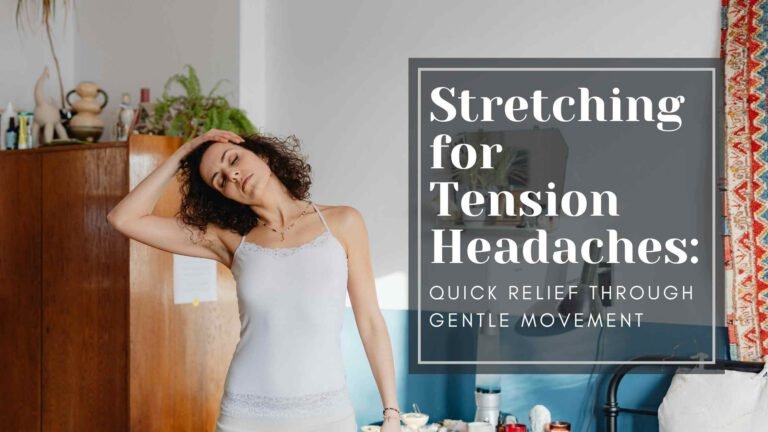
3. Gentle Neck Side Bend
Primary focus: Neck flexibility
Position: Seated or standing
Difficulty: Easy
This movement gently stretches the muscles along the side of the neck.
How to do it
- Sit or stand upright.
- Relax your shoulders.
- Slowly move one ear toward the same-side shoulder.
- Stop when you feel gentle tension on the opposite side of the neck.
- Return to center.
- Repeat on the other side.
Avoid forcefully pulling your head downward with your hand.
For additional technique and variations, see the neck side bend stretch and neck stretches.
4. Ankle Circles
Primary focus: Ankle mobility
Position: Seated
Difficulty: Very easy
Ankle circles are technically a mobility exercise rather than a static stretch. They allow the ankle to move actively through several directions while the body remains supported.
How to do them
- Sit securely in a chair.
- Lift one foot slightly from the floor.
- Slowly make circles with the ankle.
- Reverse direction.
- Lower the foot.
- Repeat with the other ankle.
Use a comfortable range rather than trying to make the largest possible circle.
5. Cat-Cow
Primary focus: Spinal mobility
Position: Hands and knees
Difficulty: Moderate
Cat-Cow gently moves the spine between flexion and extension.
How to do it
- Begin on your hands and knees on a comfortable surface.
- Slowly move your chest and pelvis as your back gently extends.
- Reverse the movement and gently round your back.
- Continue through a comfortable range.
- Breathe normally throughout the movement.
The full Cat-Cow stretch guide explains the movement in greater detail.
What if getting onto the floor is difficult?
Do not force a floor exercise simply because it appears in a routine. A smaller seated version can be more practical for someone who has difficulty getting down to or rising from the floor.
FlexologyGuide’s chair stretches for seniors provides a more appropriate pathway for people who prefer seated exercise.
6. Seated Spinal Rotation
Primary focus: Trunk and thoracic mobility
Position: Seated
Difficulty: Easy to moderate
A gentle seated rotation can move the upper trunk without requiring standing balance.
How to do it
- Sit upright with both feet supported.
- Keep your hips facing forward.
- Slowly rotate your upper body toward one side.
- Stop within a comfortable range.
- Return to center.
- Repeat in the opposite direction.
Do not use the chair or your arms to force yourself into a deeper rotation.
See the seated spinal twist and thoracic rotation stretch for additional guidance.
A special consideration for osteoporosis
Spinal movements may require modification for people with osteoporosis, very low bone density or previous vertebral fractures.
The Bone Health & Osteoporosis Foundation advises people with osteoporosis to avoid bending forward from the waist and twisting the spine to a point of strain. Individual recommendations can vary according to fracture risk and medical history.
If osteoporosis or previous spinal fractures are a concern, a physical therapist or other qualified healthcare professional can help determine which movements are appropriate.
7. Heel-to-Toe Rocking
Primary focus: Lower-leg control and balance
Position: Supported standing
Difficulty: Moderate
Heel-to-toe rocking is better classified as a balance and movement exercise than a traditional stretch.
How to do it
- Stand facing a countertop or another sturdy support.
- Keep your hands close to or on the support.
- Slowly rise toward the balls of your feet.
- Lower your heels.
- Shift backward gently and lift the front of the feet if comfortable.
- Return to neutral.
- Repeat slowly.
The Bone Health & Osteoporosis Foundation includes supported toe-and-heel rocking among exercises that may help people work on balance.
Do not perform the movement unsupported if you are uncertain about your stability.
8. Chest Opener
Primary focus: Chest and front-of-shoulder flexibility
Position: Seated or standing
Difficulty: Easy
A gentle chest opener moves the shoulders away from a rounded-forward position without requiring an aggressive stretch.
How to do it
- Sit or stand upright.
- Relax your shoulders.
- Gently draw the shoulders back.
- Move the arms slightly behind your body if comfortable.
- Stop when you feel mild tension through the chest.
- Continue breathing normally.
A wall or doorway can provide another option.
See the doorway chest stretch and FlexologyGuide’s upper-body stretches for additional movements.
9. Supported Single-Leg Balance
Primary focus: Balance
Position: Supported standing
Difficulty: Moderate
A supported single-leg stance provides a simple way to work on balance without requiring a full yoga pose.
How to do it
- Stand next to a stable countertop or sturdy chair.
- Keep one or both hands on the support as needed.
- Shift your weight onto one leg.
- Lightly lift the opposite foot.
- Maintain the position only while you feel stable.
- Lower the foot.
- Repeat on the opposite side.
The CDC identifies standing on one foot as an example of balance activity for older adults.
The objective is controlled stability, not achieving a difficult pose or removing support before you are ready.
A Simple Stretching and Mobility Routine for Seniors
You do not have to perform all nine movements every time.
A simple routine can combine several types of movement:
| Movement | Main purpose | Position |
|---|---|---|
| Ankle circles | Ankle mobility | Seated |
| Seated hamstring stretch | Hamstring flexibility | Seated |
| Standing calf stretch | Calf flexibility | Supported standing |
| Neck side bend | Neck flexibility | Seated or standing |
| Chest opener | Chest/shoulder flexibility | Seated or standing |
| Cat-Cow | Spinal mobility | Floor or modified |
| Seated spinal rotation | Trunk mobility | Seated |
| Heel-to-toe rocking | Balance and lower-leg control | Supported standing |
| Supported single-leg stance | Balance | Supported standing |
The appropriate routine is the one you can perform safely and consistently. Deeper stretching is not automatically better.
What If You Can’t Get Down on the Floor?
You can work on flexibility and mobility without performing floor exercises.
Chair-supported exercise may be particularly useful for people who:
- Have difficulty getting down to the floor
- Have difficulty standing back up
- Need additional balance support
- Are returning to activity after a period of inactivity
- Prefer seated exercise
Start with FlexologyGuide’s dedicated chair stretches for seniors guide or explore the broader chair stretches collection.
How Does Stretching Fit With Strength and Balance Training?
Stretching complements strength and balance training; it does not replace them.
This is one of the most important distinctions for older adults.
Current CDC guidance for adults 65 and older recommends at least 150 minutes of moderate-intensity aerobic activity per week, muscle-strengthening activities on at least two days per week and activities that improve balance.
People who cannot meet those targets should be as physically active as their abilities and health conditions allow.
A broader movement program can therefore include:
- Stretching for flexibility
- Mobility exercises for controlled range of motion
- Resistance exercise for strength
- Balance exercises for stability
- Walking or other aerobic activity for cardiovascular fitness
Some activities, including certain forms of yoga, Pilates and tai chi, can combine several physical capacities in one activity.
Should Seniors Stretch Before or After Walking?
For most people, it makes sense to warm the body with comfortable movement before performing deeper static stretching.
The National Institute on Aging recommends stretching when the muscles are warmed up.
Before a walk, this can mean beginning with several minutes of easy movement rather than immediately forcing a cold muscle into a deep stretch. More deliberate flexibility work can be performed after warming up or following the walk if it feels comfortable.
How Often Should Seniors Stretch?
There is no single stretching schedule appropriate for every older adult.
Frequency depends on factors including:
- Current flexibility
- Activity level
- Health conditions
- Joint limitations
- Exercise program
- Individual goals
- Recovery and response to exercise
Regular gentle stretching can be incorporated into a broader weekly movement program, but there is no reason to force painful stretches or pursue extreme flexibility.
Consistency and comfortable technique are more important than trying to make every stretch deeper.
Is Stretching Safe for Seniors With Arthritis?
Many people with arthritis can remain physically active, but the appropriate movements depend on the affected joints, symptoms and overall health.
Gentle range-of-motion and flexibility exercises may be incorporated into a broader activity program. Stretching should not, however, be presented as a cure for arthritis or as a guaranteed way to eliminate joint pain.
A movement that repeatedly causes substantial pain or worsening symptoms should be reconsidered rather than pushed through.
Is Stretching Safe for Seniors With Osteoporosis?
Stretching and exercise can still be part of an active lifestyle for people with osteoporosis, but some movements require additional caution.
The Bone Health & Osteoporosis Foundation advises people with spinal bone loss to avoid movements such as forward bending from the waist and extreme twisting of the trunk. Certain yoga and Pilates movements may also require modification.
People who have recently fractured a bone, have very low bone density or have experienced vertebral fractures should consider individualized guidance before beginning a new exercise program.
The goal is not to avoid movement. It is to choose movement appropriate to the person’s fracture risk and abilities.
Can Stretching Prevent Falls?
Stretching alone should not be considered a fall-prevention program.
Improved flexibility may support comfortable movement, but fall prevention involves additional factors, including balance, strength, medications, vision, environmental hazards and individual health conditions.
The CDC emphasizes multicomponent physical activity that includes balance and muscle-strengthening work for older adults.
That is why this guide includes supported balance movements alongside traditional stretches rather than presenting flexibility as the only physical quality that matters.
Can Assisted Stretching Help Seniors?
Assisted stretching can provide another way to work on flexibility for older adults who prefer one-on-one guidance.
During assisted stretching, another person helps position or move the body through selected stretches. The exact approach varies among providers, and assisted stretching in a wellness or fitness studio should not be confused with physical therapy or medical rehabilitation.
Older adults considering the service may want to ask:
- What training does the practitioner have?
- Does the provider regularly work with older adults?
- How are stretches modified for limited mobility?
- What health conditions should be disclosed before a session?
- How long are sessions?
- What does a session cost?
- Is a membership required?
FlexologyGuide’s assisted stretching for seniors guide examines the service specifically from an older-adult perspective.
Readers who are new to the service can also learn how to start assisted stretching and what a Flexologist is.
When finding a provider is the next step, use FlexologyGuide’s Assisted Stretching Studio Search to explore assisted-stretching providers.
Can Pilates Be Useful for Older Adults?
Pilates is not simply another form of stretching. Depending on the program, Pilates can incorporate controlled movement, strength, mobility, posture and balance.
That can make it relevant to older adults who want a more structured movement practice, although class difficulty and exercise selection vary considerably.
FlexologyGuide’s Pilates for seniors guide examines this specifically. You can also learn whether Pilates is safe and whether Pilates is beginner friendly.
For broader education, visit the Pilates Guide. Readers ready to compare local options can use FlexologyGuide’s Pilates Studio Search.
When Should an Older Adult Stop Stretching?
Stop a movement if it causes sharp or severe pain or makes you feel unsafe.
Seek appropriate medical attention for concerning symptoms such as:
- Chest pain
- New or severe shortness of breath
- Sudden weakness
- Significant dizziness or fainting
- New numbness or neurological symptoms
- Severe or unexplained pain
- Symptoms following a significant fall or injury
People recovering from surgery or fracture, or those with medical conditions affecting the heart, bones, joints, nerves or balance, may need individualized guidance before beginning or substantially changing an exercise program.
Stretching is an exercise tool—not a substitute for diagnosing unexplained symptoms.
Frequently Asked Questions
What are the best stretches for seniors?
Useful options for many older adults include gentle hamstring, calf, neck and chest stretches combined with ankle and spinal mobility. The best choices depend on mobility, balance, health history and the activities a person wants to perform more comfortably.
What are the easiest stretches for seniors?
Seated hamstring stretches, ankle circles, gentle neck movements and supported calf stretches are accessible starting points for many people. Chair-based routines can further reduce balance and floor-transfer demands.
Should seniors stretch every day?
Some older adults comfortably perform gentle mobility or stretching daily, while others include it several times per week. The appropriate schedule depends on the individual and should fit within a broader program that also addresses strength, balance and aerobic activity.
How long should seniors hold a stretch?
A stretch should be controlled and comfortable rather than forced to meet an arbitrary timer. Maintain normal breathing and stop before the position becomes painful. Individual exercise prescriptions may differ when a clinician or physical therapist is addressing a specific limitation.
Can stretching improve balance?
Stretching primarily addresses flexibility. Balance is a separate physical skill that should be trained directly. Some movement programs incorporate both, but stretching alone should not be expected to produce the same adaptations as dedicated balance training.
Can stretching prevent falls in seniors?
Stretching alone is not a complete fall-prevention strategy. Balance and muscle-strengthening activity are important components of physical activity recommendations for older adults, and fall risk can also involve health, medication and environmental factors.
Can seniors stretch if they have osteoporosis?
Often yes, but exercise selection matters. People with osteoporosis or vertebral fracture risk may need to avoid or modify deep forward spinal bending, extreme twisting and movements that substantially increase fall risk.
Is assisted stretching appropriate for seniors?
It can be an option for some older adults who want guided flexibility work. Suitability depends on health status, mobility, goals and provider qualifications. Assisted stretching in a fitness or wellness setting is not a substitute for physical therapy or medical care.
Is chair stretching effective for older adults?
Chair-based stretching can provide a practical way to work on flexibility and mobility when standing balance or getting onto the floor is difficult. The chair is a modification, not an indication that the movement is less worthwhile.
Related Resources
Continue exploring FlexologyGuide’s senior mobility, stretching and movement resources:
- Stretch Library
- Stretching Guide
- Chair Stretches for Seniors
- Chair Stretches
- Assisted Stretching for Seniors
- What Is Assisted Stretching?
- Hamstring Stretches
- Calf Stretches
- Neck Stretches
- Upper-Body Stretches
- Pilates for Seniors
- Pilates Guide
- Assisted Stretching Studio Search
- Pilates Studio Search
The Bottom Line
Stretching can be a valuable part of healthy movement as you age because maintaining flexibility can make exercise and everyday activities easier. But flexibility is only one part of physical function.
A more complete approach combines flexibility and mobility work with strength, balance and aerobic activity appropriate to your abilities.
Start with movements you can control comfortably. Use a chair, wall or countertop when support improves safety. Modify exercises rather than forcing your body into positions that hurt or feel unstable.
Most importantly, choose movement based on what you are trying to improve. Stretch when flexibility is the goal, practice balance when stability is the goal, strengthen when physical capacity is the goal, and combine them when maintaining overall mobility is the priority.