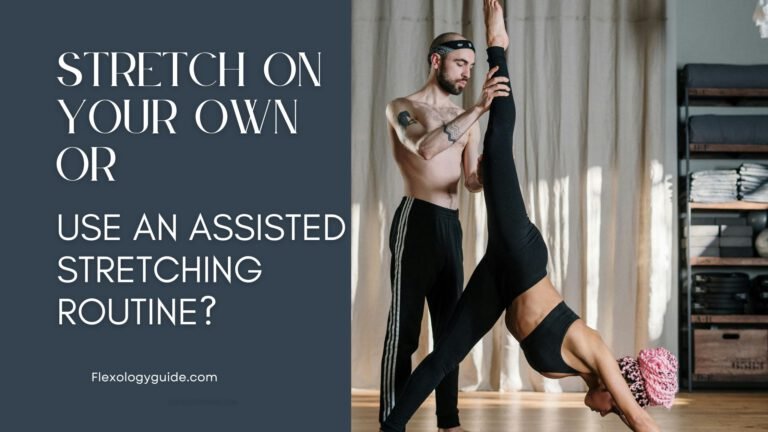
Assisted stretching may help some people with sciatica improve mobility, reduce muscle tightness, and find more comfortable ways to move—but it does not directly treat every cause of sciatic nerve pain.
That distinction matters.
Sciatica commonly develops when one or more nerve roots in the lower spine are irritated or compressed, often because of a herniated disk or changes that narrow the space around a nerve. Stretching cannot simply “release” a compressed spinal nerve or reverse a structural problem.
However, gentle stretching and movement are commonly included in conservative sciatica management. Assisted stretching may be useful when limited hip or lower-body mobility and muscular tightness are contributing to movement restrictions—as long as the stretches do not increase radiating pain, numbness, tingling, or weakness.
The best question therefore is not:
“Can assisted stretching cure sciatica?”
It is:
“Is stretching appropriate for the cause and symptom pattern of my sciatica, and can professional assistance help me perform it comfortably?”
For the broader service overview, see FlexologyGuide’s Assisted Stretching Guide.
What Is Sciatica?
Sciatica describes symptoms associated with irritation or compression of the nerve roots that contribute to the sciatic nerve.
The sciatic nerve extends from the lower back and travels through the buttock and down the leg. Symptoms commonly follow some portion of this pathway.
Sciatica may cause:
- Low-back or buttock pain
- Pain traveling down the back or side of the leg
- Burning pain
- Sharp or electric-shock-like pain
- Tingling
- Numbness
- Leg or foot weakness
Symptoms typically affect one side.
Mayo Clinic notes that sciatica commonly occurs when a herniated disk or an overgrowth of bone puts pressure on lumbar nerve roots.
That is important because the source of the symptoms is often upstream in the spine, even though the pain is felt farther down the leg.
What Causes Sciatica?
Sciatica is a symptom pattern rather than a single underlying disease.
Possible causes include:
Herniated Disk
A spinal disk can bulge or herniate and place pressure on a nearby nerve root.
This is one of the most common causes of sciatica.
Spinal Stenosis and Bony Changes
Changes in the spine can reduce the space available for nerve roots and contribute to irritation or compression.
Other Spinal Conditions
Less common causes can also affect nerve roots.
Because multiple conditions can produce similar symptoms, persistent or severe sciatica should not automatically be diagnosed as a tight muscle.
What About Piriformis Syndrome?
This requires an important distinction.
Pain originating around the piriformis and deep gluteal region can resemble sciatica. The sciatic nerve passes through the buttock region, and irritation outside the spine can sometimes produce sciatic-like symptoms.
But that does not mean most sciatica comes from a tight piriformis.
Before repeatedly stretching the piriformis because pain travels down your leg, consider whether the actual source may be the lumbar spine.
That distinction can substantially change the appropriate treatment strategy.
Can Assisted Stretching Help Sciatica?
Potentially—but its role depends on the individual.
Mayo Clinic includes stretching among self-care approaches that may provide relief for some people with sciatica and recommends avoiding jerking, bouncing, or twisting during stretches. It also notes that physical therapy programs can include exercises intended to improve posture, strengthen the core, and improve range of motion.
Assisted stretching can potentially complement this approach by helping a person work on mobility with another person controlling or supporting the movement.
Potential benefits may include:
- Improving hip mobility
- Improving comfortable range of motion
- Addressing calf, hamstring, hip, or gluteal tightness when relevant
- Helping a person relax during a stretch
- Providing controlled positioning
- Identifying movements that feel comfortable versus provocative
- Supporting an overall mobility routine
But these are mobility benefits.
They should not be confused with directly removing pressure from a spinal nerve root.
What Assisted Stretching Cannot Do
This is one of the most important sections of this guide.
Assisted stretching should not be described as a way to:
- Push a herniated disk back into place
- Reverse spinal stenosis
- Directly decompress a spinal nerve root
- “Realign” the spine
- Cure sciatica
- Guarantee reduced inflammation
- Repair nerve damage
- Replace physical therapy or medical care when those are needed
The legacy version of this article overstated several of these mechanisms.
A more accurate description is that assisted stretching can be a mobility and wellness service that may complement an appropriate sciatica-management plan.
When Stretching May Be Most Useful
Stretching may make more sense when symptoms coexist with meaningful mobility restrictions.
For example, someone may have:
- Tight hips after prolonged sitting
- Reduced hip rotation
- Calf tightness
- General lower-body stiffness
- Limited comfortable movement after avoiding activity
- Muscular guarding around the hips or lower back
In these circumstances, improving comfortable mobility may make everyday movement easier.
The important word is comfortable.
Sciatic nerve symptoms should not simply be stretched harder because a muscle feels tight.
When Stretching Can Make Sciatica Worse
More stretching is not always better.
A movement that increases tension on an irritated nerve can sometimes reproduce or intensify symptoms.
Stop or modify a stretch if it causes:
- Increasing pain farther down the leg
- New or worsening numbness
- Increasing tingling
- Burning or electric sensations
- New weakness
- Symptoms that remain substantially worse afterward
A useful practical distinction is between a tolerable muscular stretching sensation and reproduction of neurological symptoms.
A stretch does not need to hurt to be effective.
Does the Sciatic Nerve Need to Be Stretched?
Not in the same way a muscle does.
Nerves need to tolerate movement relative to surrounding tissues, but aggressively pulling on an irritated nerve is different from lengthening a tight hamstring.
This is why rehabilitation professionals sometimes use neural mobilization or nerve-gliding techniques rather than simply applying a stronger static stretch.
These movements are intended to mobilize the nervous system in a controlled way.
They are not the same as trying to stretch the sciatic nerve as far as possible.
If neurological symptoms are significant, professional guidance is particularly valuable.
Assisted Stretching vs Self-Stretching for Sciatica
Assisted stretching is not inherently more effective than self-stretching.
Each has advantages.
| Self-Stretching | Assisted Stretching |
|---|---|
| Free | Usually paid |
| Can be performed frequently at home | Practitioner controls/supports movement |
| Person controls intensity directly | May make certain positions easier |
| Easy to integrate into a daily routine | Can provide external feedback |
| Requires learning appropriate technique | Quality depends heavily on practitioner training |
| Can be stopped immediately | Communication with practitioner is essential |
For many people, the strongest approach may involve learning safe movements that can be performed independently and using professional services when additional guidance or assistance is useful.
Assisted stretching should complement self-management—not create dependence on someone else to move your body.
Assisted Stretching vs Physical Therapy for Sciatica
These services are not interchangeable.
Assisted Stretching
A typical assisted-stretching session focuses primarily on flexibility and mobility.
Depending on the provider and jurisdiction, a stretch practitioner may not be a licensed healthcare professional and may not diagnose the source of sciatica.
Physical Therapy
A physical therapist is a licensed healthcare professional who can evaluate movement, strength, function, and other factors relevant to rehabilitation within their professional scope.
A sciatica rehabilitation program may include:
- Exercise
- Strengthening
- Mobility work
- Movement modification
- Education
- Progressive return to activity
Mayo Clinic notes that physical therapy may be used to develop exercises that improve posture, strengthen the core, and improve range of motion.
If you have persistent neurological symptoms, substantial weakness, or an unclear diagnosis, clinical evaluation should take priority over booking a general wellness service.
Assisted Stretching vs Massage for Sciatica
Massage and assisted stretching also serve different purposes.
Massage primarily works with soft tissue through pressure and manipulation.
Assisted stretching primarily uses guided movement and positioning to work on mobility.
Mayo Clinic notes that massage may help loosen larger back and hip muscles that are tight or in spasm, but that does not mean massage removes spinal nerve compression.
Some people may enjoy combining massage and stretching as part of general mobility or recovery, but neither should be presented as a universal treatment for the underlying cause of sciatica.
Assisted Stretching vs Chiropractic Care
Chiropractic care and assisted stretching use different approaches.
A chiropractor may use spinal manipulation and other interventions, while assisted stretching generally focuses on guided mobility.
Mayo Clinic lists spinal manipulation among alternative approaches sometimes used for low-back pain.
The appropriate choice depends on symptoms, diagnosis, preferences, and professional medical advice where needed.
Stretches Commonly Considered for Sciatica
There is no universal sciatica stretch routine.
The right movement depends on which positions improve or aggravate symptoms.
However, several mobility exercises are commonly considered.
Figure-Four / Piriformis Stretch
A figure-four position targets muscles around the hip and buttock.
A common version:
- Lie on your back with both knees bent.
- Cross one ankle over the opposite thigh.
- Keep the crossed knee comfortably open.
- Gently bring the supporting leg toward you.
- Stop if symptoms begin traveling farther down the leg.
An assisted version allows another person to help support the leg and control the amount of movement.
This may be useful for hip mobility, but it should not automatically be described as “releasing the sciatic nerve.”
Hamstring Stretch
Hamstring flexibility may be relevant for some people, but hamstring stretching deserves caution when sciatica is active.
Why?
Straightening the knee while flexing the hip can also increase tension through neural structures.
If a traditional hamstring stretch produces burning, tingling, numbness, or radiating pain, do not assume that means the hamstring simply needs a deeper stretch.
Modify or stop the movement.
Gentle Hip-Flexor Stretch
People who spend substantial time sitting may feel stiffness around the front of the hips.
A gentle hip-flexor stretch may improve comfort and hip mobility without directly placing the sciatic nerve under the same tension as some straight-leg positions.
Keep the spine comfortable rather than forcing an exaggerated arch.
Cat-Cow
Cat-cow moves the spine through gentle flexion and extension.
Start on your hands and knees and slowly alternate between rounding and extending the spine within a comfortable range.
The objective is movement—not forcing maximum spinal range.
Stop if the movement increases radiating symptoms.
Knee-to-Chest Movement
A gentle knee-to-chest movement may feel comfortable for some people.
Lie on your back and bring one knee toward the torso without forcing it.
Again, symptom response matters more than whether a stretch appears on a generic “best sciatica stretches” list.
What About Nerve Glides?
Nerve glides, sometimes called neural mobilizations, are different from conventional muscle stretches.
Instead of holding the nervous system at maximum tension, the movement changes joint positions in a coordinated way.
Because technique and symptom response matter, someone with significant sciatica may benefit from learning nerve-mobilization exercises from a qualified rehabilitation professional rather than copying an aggressive online routine.
A Better Rule: Follow Your Symptoms
With sciatica, where symptoms move can matter.
If a movement makes pain travel farther down the leg, that is generally a reason to stop and reassess.
If symptoms become less intense or retreat from the lower leg toward the back or buttock, that can represent a different response.
Do not use this observation as a substitute for diagnosis, but do use symptom behavior as feedback.
The goal of a mobility session should not be to tolerate the most intense stretch possible.
What Happens During an Assisted Stretching Session?
The exact experience depends on the studio and practitioner.
A typical session may include:
Discussion
You may be asked about:
- Areas of tightness
- Current activity
- Mobility goals
- Previous injuries
- Positions that feel uncomfortable
If you have diagnosed sciatica, tell the practitioner.
Also disclose radiating pain, numbness, tingling, weakness, recent injuries, surgeries, or medical restrictions.
Mobility Assessment
Some providers perform basic range-of-motion or mobility checks.
This is not necessarily a medical diagnosis.
Guided Stretching
You remain on a table or other supported surface while the practitioner moves one or more joints through controlled ranges.
Communication is critical.
Tell the practitioner immediately if a stretch reproduces nerve symptoms.
Follow-Up
A practitioner may suggest general mobility exercises between sessions.
Medical rehabilitation recommendations should come from appropriately qualified healthcare professionals.
How Often Should You Use Assisted Stretching for Sciatica?
There is no evidence-based universal prescription of two or three assisted-stretching sessions per week for sciatica.
The legacy article made that recommendation too broadly.
Frequency depends on:
- Why you are stretching
- Symptom irritability
- Other rehabilitation activities
- Response after each session
- Practitioner recommendations
- Healthcare guidance when applicable
A useful service should produce a measurable benefit in movement or comfort without repeatedly aggravating neurological symptoms.
More sessions are not automatically better.
How Quickly Should Assisted Stretching Help?
There is no reliable number of sessions after which sciatica should improve.
Some people may feel temporarily looser after one session.
That is not the same as resolving the cause of sciatica.
Sciatica related to a herniated disk can improve over weeks to months, and many cases improve without surgery.
Judge progress using broader indicators:
- Less radiating pain
- Improved walking tolerance
- Improved sitting tolerance
- Fewer neurological symptoms
- Better sleep
- Improved strength
- Improved ability to perform normal activities
How Much Does Assisted Stretching Cost?
Pricing varies by studio, session length, market, and whether you purchase a single visit, package, or membership.
Common assisted-stretching formats include:
- Introductory sessions
- 25- or 30-minute sessions
- 50- or 60-minute sessions
- Multi-session packs
- Monthly memberships
Because prices vary significantly by provider and location, FlexologyGuide’s national Studio Search is more useful than assigning one national price to assisted stretching.
When comparing providers, consider not only cost but also practitioner qualifications, session length, cancellation policies, and whether the provider is comfortable working with someone who has sciatica.
Find Assisted Stretching Near You
If assisted stretching is appropriate for your situation, FlexologyGuide can help you compare providers.
Use the FlexGuide Studio Search to find assisted-stretching studios and other movement and recovery providers in your area.
You can compare local options rather than relying on a generic national recommendation.
FlexologyGuide’s provider database is designed to help consumers understand what services are actually available near them and decide which type of provider fits their goal.
When You Should Not Start With an Assisted Stretching Studio
Some symptoms need medical attention rather than a mobility appointment.
Seek immediate medical care for symptoms such as:
- New loss of bowel or bladder control
- Significant or sudden leg weakness
- Severe or rapidly worsening numbness
- Numbness around the groin, inner thighs, or saddle region
- Severe symptoms following significant trauma
Mayo Clinic identifies bowel or bladder changes and sudden numbness or weakness as reasons for immediate medical care in people with sciatica. Saddle-area numbness combined with bowel/bladder or worsening neurological symptoms can indicate cauda equina compression, which is a medical emergency.
You should also consider a healthcare evaluation when pain is severe, continues to worsen, or does not improve with reasonable self-care.
Can You Stay Active With Sciatica?
For many people, prolonged inactivity is not the answer.
Mayo Clinic notes that while a short period of rest may temporarily relieve symptoms, staying inactive can worsen them.
The better goal is often appropriate activity.
That may mean temporarily modifying:
- Running
- Heavy lifting
- Long periods of sitting
- High-impact exercise
- Movements that repeatedly provoke leg symptoms
while maintaining comfortable walking, rehabilitation exercises, and other tolerable movement.
Can Pilates Help During Sciatica Recovery?
Pilates is not a treatment for every cause of sciatica, but its emphasis on controlled movement and trunk strength may make appropriately modified Pilates useful for some people during recovery.
Mayo Clinic notes that physical therapy programs for sciatica can include core strengthening and exercises intended to improve posture and range of motion.
That does not establish Pilates itself as a sciatica treatment.
If you choose Pilates while symptoms are active, exercises should be modified around symptom response.
See FlexologyGuide’s Pilates Guide to understand the format before choosing a studio.
What About Recovery Studios?
Recovery studios may offer services such as massage, compression, heat, cold, or other recovery modalities.
These services may influence comfort or recovery experience, but a general recovery modality should not be assumed to remove spinal nerve compression.
The underlying cause still matters.
FlexGuide’s Studio Search can help you compare recovery providers when adjunctive recovery services fit your broader plan.
Frequently Asked Questions
Can assisted stretching help sciatica?
It may help some people improve mobility or reduce associated muscular tightness. However, assisted stretching does not directly correct every cause of sciatica, such as a herniated disk or spinal stenosis. Whether it is appropriate depends on the cause and how your symptoms respond to movement.
Can stretching make sciatica worse?
Yes. Some positions can increase tension or irritation around an already sensitive nerve. Stop or modify a stretch if it increases radiating pain, numbness, tingling, burning, or weakness.
What is the best stretch for sciatica?
There is no single best stretch. Sciatica has different causes and symptom patterns. A movement that helps one person may aggravate another. The best approach is based on the underlying problem and your response to movement.
Is a piriformis stretch good for sciatica?
It may help when hip or deep-gluteal tightness is relevant, but most sciatica should not automatically be attributed to the piriformis. Many cases originate from irritation or compression of nerve roots in the lumbar spine.
Should I stretch my hamstrings if I have sciatica?
Possibly, but cautiously. Some hamstring-stretching positions also increase neural tension. If the stretch produces radiating pain, tingling, numbness, or burning, stop or modify it.
Is assisted stretching better than stretching at home?
Not inherently. Self-stretching is inexpensive, accessible, and gives you direct control over intensity. Assisted stretching can provide positioning, support, and external guidance. The better option depends on your needs and the quality of instruction.
Is assisted stretching the same as physical therapy?
No. Assisted stretching is generally a mobility/wellness service. Physical therapists are licensed healthcare professionals who can evaluate and rehabilitate musculoskeletal and movement problems within their scope of practice.
How many assisted-stretching sessions do I need for sciatica?
There is no established number. Be cautious of promises that sciatica will resolve after a particular number of assisted-stretching sessions.
Can assisted stretching cure a herniated disk?
No. Assisted stretching should not be represented as reversing or repositioning a herniated spinal disk.
Can assisted stretching cure sciatica?
No single mobility service can promise to cure sciatica because sciatica has multiple potential causes. Stretching may be one component of conservative management for some people.
Should I stretch through sciatic nerve pain?
Do not assume radiating nerve pain is a sensation you need to push through. Increasing neurological symptoms during a stretch are a reason to reduce the movement, stop, or seek professional guidance.
When is sciatica an emergency?
Seek immediate medical attention for new bowel or bladder control problems, major or sudden weakness, significant worsening numbness, or saddle-area numbness. These symptoms can indicate serious nerve compression.
Related FlexologyGuide Resources
Assisted Stretching Guide — Learn how one-on-one assisted stretching works, what happens during a session, and how it differs from stretching alone.
Sciatica Stretch Library — Explore individual movements and understand how symptom response should guide stretching.
Stretch Library — Browse FlexologyGuide’s broader movement and flexibility library.
Pilates Guide — Learn how Pilates approaches controlled movement, mobility, and strength.
Bottom Line
Assisted stretching can have a role in a sciatica-management plan, but its role needs to be described accurately.
Sciatica frequently originates from irritation or compression of nerve roots in the lower spine. Assisted stretching cannot simply “release” that compression, reverse spinal stenosis, repair a herniated disk, or guarantee pain relief.
What it may do is help some people improve comfortable hip and lower-body mobility, manage associated muscular tightness, and incorporate guided movement into a broader recovery plan.
The most important factor is symptom response.
A useful stretch should not repeatedly send pain farther down the leg or increase numbness, tingling, burning, or weakness.
And when symptoms include substantial weakness, bowel or bladder changes, saddle-area numbness, or rapidly worsening neurological problems, skip the stretch appointment and seek medical care.
For people whose symptoms have been appropriately evaluated and who want professional help with mobility, FlexGuide’s national Studio Search can help identify assisted-stretching providers nearby.