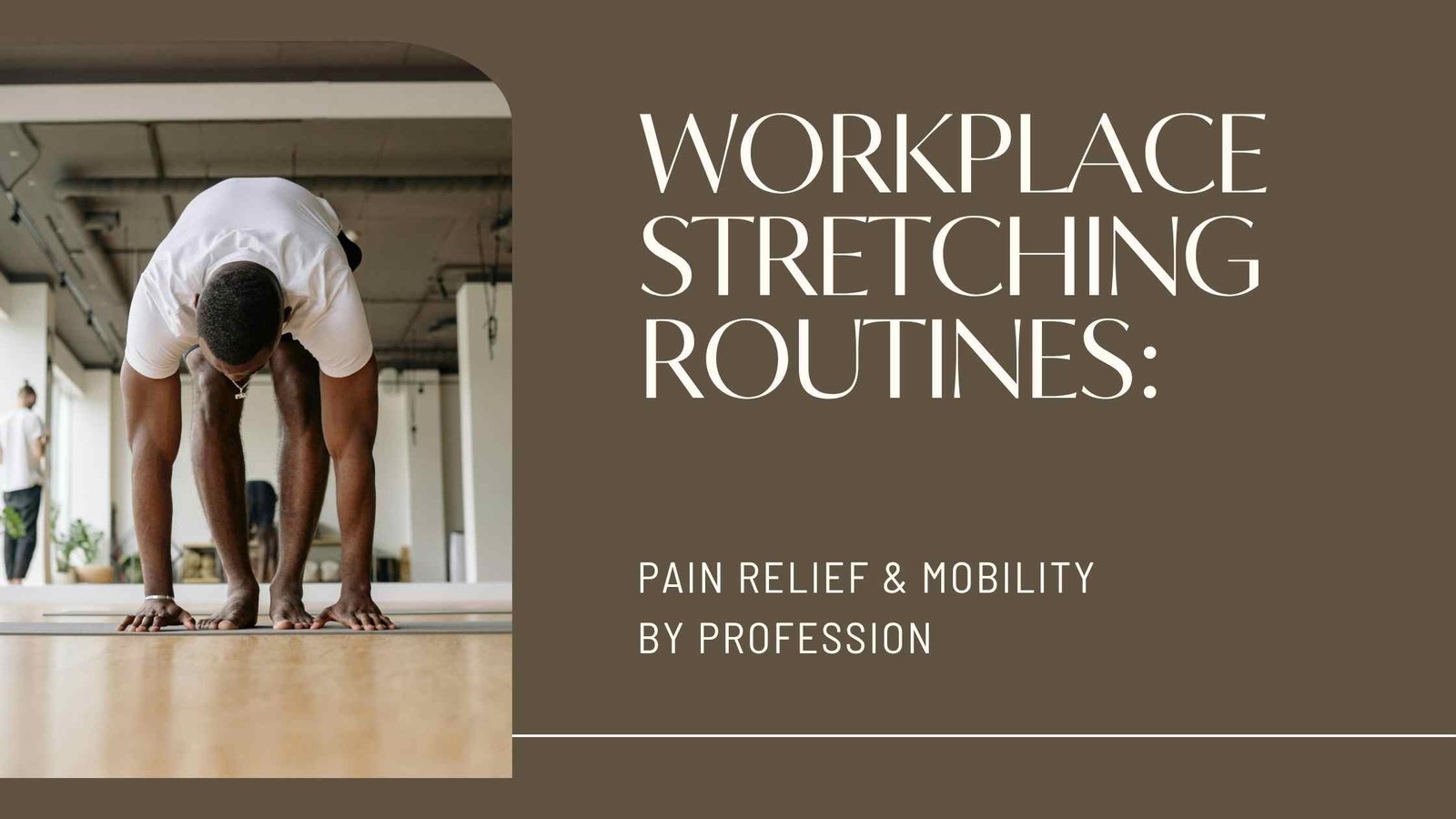

Work can make your body feel stiff whether you spend eight hours sitting at a computer, standing on a hospital floor, driving, lifting materials or repeatedly reaching overhead.
A useful workplace stretching routine should therefore match the physical demands of the job.
Desk workers may benefit most from regularly changing position and moving the neck, shoulders, chest and hips.
Drivers often need opportunities to stand, walk and move after long periods in a fixed seated position.
People working in construction, warehouses and other physical jobs may need mobility that complements repetitive lifting, carrying, kneeling and overhead work.
Healthcare and service workers who spend much of the day standing may benefit from movement for the calves, ankles, hips and back.
The important point is that workplace stretching is only one part of the solution.
The National Institute for Occupational Safety and Health emphasizes reducing prolonged sitting or standing, awkward postures and overreaching. OSHA likewise recommends changing tasks, taking short breaks, standing, stretching and moving around when work involves high repetition or prolonged static posture.
So rather than trying to find one perfect stretch for your profession, focus on this principle:
Move the areas that stay still, give repetitive movements a break, and avoid forcing stretches through pain.
Quick Guide: Workplace Stretching by Job Demand
| Work Type | Common Physical Demand | Useful Movement Focus |
|---|---|---|
| Desk or computer work | Prolonged sitting and static upper-body posture | Neck, chest, shoulders, wrists, hips |
| Driving | Long periods seated with limited position changes | Hips, back, hamstrings, calves |
| Construction/manual labor | Lifting, carrying, kneeling, reaching | Shoulders, upper back, hips, legs |
| Fitness/coaching work | Repeated demonstrations and training | Hips, hamstrings, shoulders, calves |
| Healthcare/service work | Prolonged standing and walking | Calves, ankles, hips, back |
| Remote work | Sitting with variable workstation ergonomics | Neck, shoulders, chest, hips, wrists |
You can also browse the FlexologyGuide Stretch Library for individual stretches organized by body area.
Why Movement Breaks Matter at Work
One of the biggest mistakes in workplace mobility advice is treating stretching as a way to “undo” an entire workday.
The body generally responds better to regular changes in position and activity than to staying in one position for hours and performing one long stretching session afterward.
OSHA recommends several short rest pauses when work requires long periods of static posture or repetitive activity. For computer users, its guidance specifically encourages workers to stand, stretch and walk during short breaks.
NIOSH similarly notes that short breaks can reduce discomfort for people working at computers.
That means the broader workplace strategy should include:
- Changing position regularly
- Standing after long periods of sitting
- Sitting or unloading the legs after prolonged standing
- Walking briefly when possible
- Alternating tasks when work allows
- Adjusting the workstation or work process
- Using stretching as one component of the movement break
Stretching does not compensate for a workstation that continually forces an awkward position.
How Hard Should a Workplace Stretch Feel?
A workplace stretch should generally create a mild to moderate pulling sensation, not sharp pain.
The NIH workplace ergonomics program recommends exercises for healthy adults that do not cause pain or discomfort and advises people with relevant medical concerns to seek individualized guidance.
Useful general rules include:
- Move slowly.
- Do not bounce aggressively into a stretch.
- Keep breathing normally.
- Stop if you experience sharp or increasing pain.
- Do not force a joint beyond a comfortable range.
- Modify or skip movements that reproduce numbness or tingling.
- Use extra caution after a recent injury or surgery.
Persistent pain, weakness, numbness, swelling or loss of function should not simply be treated with more stretching.
Workplace Routine 1: Desk and Computer Workers
Computer work can involve very little variation in body position.
The neck and shoulders may remain relatively static while the hands and forearms perform repetitive keyboard or mouse activity.
OSHA notes that maintaining static postures for prolonged periods can contribute to neck and shoulder fatigue, while repeated mouse and keyboard activity can repeatedly load smaller muscles and tendons.
A workplace routine for desk workers should therefore emphasize position changes as much as stretching.
1. Chin Tuck
Useful for gently moving the neck after prolonged screen work.
- Sit or stand upright.
- Look straight ahead.
- Gently draw your head straight backward without looking down.
- Pause briefly.
- Relax.
Repeat slowly several times.
See the full Chin Tuck Stretch guide for technique details.
2. Neck Side Bend
- Sit or stand tall.
- Keep both shoulders relaxed.
- Slowly tilt one ear toward the same-side shoulder.
- Stop when you feel a gentle stretch along the opposite side of your neck.
- Hold briefly and switch sides.
Do not aggressively pull your head downward.
3. Doorway Chest Stretch
Computer work often keeps the arms positioned in front of the torso.
A chest-opening movement provides a useful change of position.
- Place your forearm on a door frame.
- Keep your shoulder relaxed.
- Gently rotate your torso away.
- Stop at a comfortable stretch across the chest.
- Repeat on the other side.
See the Doorway Chest Stretch.
4. Wrist Flexor Stretch
- Extend one arm in front of you.
- Keep the elbow relatively straight.
- Gently use the opposite hand to move the wrist until you feel a mild stretch.
- Hold briefly.
- Switch sides.
See the Wrist Flexor Stretch.
Better Than Stretching Alone: Stand Up
For desk workers, one of the most useful “exercises” may simply be getting out of the chair.
Stand.
Walk to refill your water.
Take a short lap.
Change tasks.
Adjust your chair.
OSHA recommends frequent changes in working position even when the workstation itself is well designed.
For a more complete routine, see Stretches for Desk Workers.
Workplace Routine 2: Construction and Manual Labor
Construction, warehouse, trade and other manual jobs present a different challenge.
The problem usually is not insufficient activity.
It is repeated exposure to the same physical tasks.
Depending on the job, that can include:
- Overhead reaching
- Carrying
- Lifting
- Kneeling
- Squatting
- Tool use
- Repetitive gripping
- Trunk rotation
- Working in awkward positions
Stretching cannot make unsafe lifting or excessive workloads safe.
But mobility breaks can provide movement variety between repetitive tasks.
1. Cross-Body Shoulder Stretch
- Bring one arm across your chest.
- Support it gently with the opposite arm.
- Keep the stretched shoulder relaxed.
- Hold at comfortable tension.
- Switch sides.
See the Cross-Body Shoulder Stretch.
2. Upper-Back Rotation
Repeated forward-facing or overhead work may benefit from gentle thoracic movement.
Rather than aggressively twisting the lower back, use controlled upper-back rotation.
The Thoracic Rotation Stretch provides step-by-step guidance.
3. Hip Flexor Stretch
Jobs involving repeated kneeling, climbing or prolonged hip flexion may leave the front of the hips feeling stiff.
Try the Kneeling Hip Flexor Stretch when a suitable clean and safe surface is available.
4. Calf Stretch
Repeated walking, ladders, boots and prolonged standing can leave the calves feeling tight.
Use a stable wall or support.
See the Calf Wall Stretch.
For a broader routine, see Stretches for Manual Labor Workers.
Workplace Routine 3: Truck Drivers and Professional Drivers
Driving combines several characteristics that can contribute to stiffness:
- Prolonged sitting
- Limited hip movement
- Repeated pedal use
- Static arm positioning
- Few opportunities to change posture
The priority for drivers is not stretching while operating the vehicle.
Wait until the vehicle is safely parked.
When you stop, getting out and walking for a few minutes may be more valuable than immediately sitting somewhere else to stretch.
1. Standing Back Extension
After prolonged sitting:
- Stand upright.
- Place your hands around your hips or lower back for support.
- Gently move your upper body backward within a comfortable range.
- Return to neutral.
- Repeat slowly.
2. Standing Hip Flexor Movement
A brief hip-flexor stretch provides movement in the opposite direction from hours of seated hip flexion.
Keep the movement comfortable and controlled rather than forcing the pelvis forward.
3. Standing Hamstring Stretch
- Place one heel on a low, secure surface.
- Keep the knee comfortably straight rather than locked.
- Hinge slightly from the hips.
- Stop at a mild stretch along the back of the thigh.
See Standing Hamstring Stretch.
4. Calf Wall Stretch
This can be useful after repeated pedal use and prolonged sitting.
See the Calf Wall Stretch.
Don’t Forget Walking
The movement break itself is important.
A few minutes of comfortable walking during a safe stop changes hip, knee and ankle position while also giving the spine a break from the seated driving posture.
Workplace Routine 4: Healthcare and Other Standing Workers
Nurses, physicians, technicians, retail workers, restaurant employees, teachers and many other professionals can spend much of their shifts standing or walking.
This creates nearly the opposite movement problem from desk work.
Rather than needing more standing, these workers may need changes in loading and position.
Possible areas of stiffness include:
- Calves
- Ankles
- Hips
- Lower back
- Feet
1. Calf Wall Stretch
Keep the back heel down and move forward gradually until you feel a comfortable stretch.
See Calf Wall Stretch.
2. Soleus Stretch
Bending the back knee slightly shifts emphasis lower in the calf.
See the Soleus Stretch.
3. Hip Flexor Stretch
After long periods of walking and standing, gentle hip mobility can provide useful movement variation.
See Kneeling Hip Flexor Stretch when practical.
4. Brief Sitting or Unloading
If your job already requires standing for hours, another standing stretch is not always what your body needs.
When permitted, sitting briefly, changing footwear demands, shifting tasks or unloading the legs can provide useful variation.
The goal is not to stay in one “perfect” posture all day.
The goal is to avoid being trapped in the same posture or loading pattern all day.
Workplace Routine 5: Fitness Professionals and Active Jobs
Personal trainers, fitness instructors, coaches and other active professionals may accumulate significant physical work even before their own training begins.
Common demands include:
- Repeated demonstrations
- Squatting
- Lunging
- Lifting equipment
- Standing
- Coaching in bent or rotated positions
- Repeating the same movement for multiple clients
For these workers, more stretching is not automatically better.
Mobility should match the movements actually being repeated.
1. Hamstring Stretch
If the hamstrings feel restricted after repeated lifting or demonstrations, use a comfortable static stretch rather than forcing maximum range.
See Standing Hamstring Stretch or Seated Hamstring Stretch.
2. Hip Mobility
Repeated squatting and lunging can make changing hip positions valuable.
The FlexologyGuide Hip Flexor Stretches guide provides several options.
3. Shoulder Mobility
Trainers frequently demonstrate presses, pulls and overhead positions.
Choose shoulder stretches based on the movements performed rather than assuming every trainer needs the same routine.
The Upper Body Stretches guide provides options for the shoulders, chest, arms and upper back.
What About Remote Workers?
Remote work creates many of the same problems as traditional desk work, with an additional challenge: home workstations can vary dramatically.
Working from a couch, bed or improvised table can make maintaining a comfortable position difficult.
Remote workers should prioritize:
- A workable screen height
- Supported sitting when sitting
- Regular standing and walking
- Changing rooms or positions when practical
- Short movement breaks
- Wrist and shoulder movement
See Stretches for Remote Workers for a dedicated routine.
Should You Stretch Before Physical Work?
It depends on what you mean by stretching.
Immediately before physically demanding work, dynamic movement and task-specific warm-up often make more sense than long passive static holds.
Examples include:
- Arm circles
- Controlled bodyweight squats
- Walking
- Shoulder movements
- Hip circles
- Practice lifts with minimal load
The goal is to prepare for the movements that follow.
Long static stretching sessions are better treated as flexibility work rather than a universal pre-work requirement.
How Often Should You Take a Movement Break?
There is no single schedule that fits every occupation.
OSHA’s computer-workstation guidance recommends frequent short breaks and gives an example of a five-minute break from computer tasks each hour.
NIOSH also notes evidence supporting short hourly breaks for reducing computer-related discomfort.
That does not mean every worker needs an exact hourly stretching prescription.
A practical approach is to avoid spending very long periods in one position when your job permits movement.
For desk workers, that may mean standing or walking periodically.
For standing workers, it may mean sitting or unloading the legs.
For repetitive manual work, it may mean rotating tasks.
The change in exposure is often more important than checking a box labeled “stretching.”
Does Workplace Stretching Prevent Injuries?
This claim needs caution.
Workplace exercise programs have shown benefits in some studies for musculoskeletal discomfort, but stretching alone should not be presented as guaranteed injury prevention.
For example, a randomized trial of office workers found reductions in neck, shoulder and lower-back discomfort among workers performing an exercise program. However, occupational research as a whole is more complex, and outcomes depend on the work environment, adherence, ergonomics and the intervention used.
You can review the study through PubMed Central.
NIOSH research on data-entry employees has also found that supplementary breaks reduced discomfort and eyestrain, while low adherence made it impossible to clearly establish an independent stretching effect.
That evidence supports a more practical conclusion:
Stretching can be useful, but movement breaks, ergonomics and workload management matter too.
Can Workplace Stretching Help Pain?
Stretching may make some people feel temporarily less stiff or more comfortable.
But workplace pain can have many causes.
A stretch should not be used to self-diagnose:
- Persistent neck pain
- Back pain
- Numbness
- Tingling
- Weakness
- Joint swelling
- Radiating pain
- Recurrent work-related symptoms
If symptoms persist, worsen or interfere with normal function, appropriate medical or occupational-health evaluation is more important than adding more stretches.
Is Assisted Stretching Useful for Workers?
Some people prefer having another person guide their stretching rather than performing every movement independently.
Assisted stretching generally involves a trained provider helping position the body through controlled stretches.
It may appeal to people who:
- Prefer guided sessions
- Want help with positioning
- Have difficulty relaxing during self-stretching
- Want a structured flexibility session
It should not be described as accessing “deeper muscle layers,” curing repetitive strain or automatically producing better recovery than self-stretching.
Assisted stretching is also a wellness service, not a replacement for medical care, physical therapy or occupational-health evaluation when those services are appropriate.
If you want to compare providers, use the FlexologyGuide Stretch Studios Near Me search.
A Simple 5-Minute Workplace Movement Break
When you do not need a job-specific routine, use this simple sequence as a general movement break.
Minute 1: Walk or Change Position
Stand if you have been sitting.
Walk briefly if space and work conditions allow.
If you have been standing for a prolonged period, sit or unload the legs instead.
Minute 2: Neck and Shoulders
Perform gentle:
- Chin tucks
- Neck side bends
- Shoulder rolls
Avoid forcing the neck into extreme positions.
Minute 3: Chest and Upper Back
Try:
- Doorway chest stretch
- Gentle thoracic rotation
- Shoulder-blade movement
Minute 4: Hips
Try:
- Gentle hip-flexor stretch
- Hip circles
- Comfortable bodyweight movement
Minute 5: Legs and Ankles
Try:
- Calf stretch
- Hamstring stretch
- Ankle movement
You do not need to perform every stretch every time.
Choose movements that provide a comfortable change from what your job has required during the previous part of the day.
Frequently Asked Questions
What are the best stretches to do at work?
There is no single best workplace routine. Choose stretches based on what your job keeps stationary or repeatedly loads. Desk workers may prioritize the neck, shoulders, chest and hips, while standing workers may prefer calf, ankle and hip mobility.
How long should a workplace stretching break be?
Even a brief movement break can be useful. OSHA encourages frequent short breaks from prolonged computer work, including standing, stretching and walking. A workplace routine does not need to become a full workout.
Should office workers stretch every hour?
There is no universal medical requirement to stretch every hour. However, OSHA recommends frequent short rest pauses for prolonged static or repetitive work and gives an example of taking a five-minute break from computer tasks each hour.
Can stretching prevent workplace injuries?
Stretching alone has not been established as a universal workplace injury-prevention strategy. Ergonomics, task variation, recovery time, workload, training, equipment and movement all matter.
Can I stretch if I already have pain?
Gentle movement may feel comfortable for some causes of stiffness, but unexplained or persistent pain should not simply be stretched through. Stop if a movement causes sharp pain, increasing symptoms, numbness or tingling.
Should I stretch before lifting at work?
A task-specific warm-up using controlled movement is generally more appropriate than assuming long static stretches are necessary before lifting. Safe lifting technique and appropriate workload remain important.
Are workplace stretches different for standing jobs?
Often, yes. Someone who stands all day may not need more standing. Calf and ankle mobility, hip movement, changing positions and periodically unloading the legs may make more sense.
Do truck drivers need different stretches?
Drivers spend long periods seated with limited movement. After parking safely, walking, changing hip position and gently moving the back and legs may be useful.
Is workplace stretching the same as ergonomics?
No. Ergonomics changes the task or workplace to better fit the worker. Stretching changes body position temporarily. A stretching routine should not be used as a substitute for correcting an avoidable workplace ergonomic problem.
Where can I find stretches for individual body areas?
Use the FlexologyGuide Stretch Library to find individual stretching guides organized by body region and movement goal.
Conclusion
A good workplace stretching routine is not about finding a magical set of exercises for your profession.
It is about identifying what your work asks your body to do repeatedly — or prevents it from doing — and adding sensible movement variety.
If you sit most of the day, stand and move.
If you stand most of the day, periodically unload your legs.
If you drive, get out and walk when it is safe to stop.
If you lift or perform manual work, vary tasks when possible and use mobility to complement—not replace—safe work practices.
Stretching can be part of that strategy.
But workplace mobility works best when it sits alongside ergonomics, task variation, regular movement and appropriate recovery, rather than being treated as a cure for the physical demands of work.