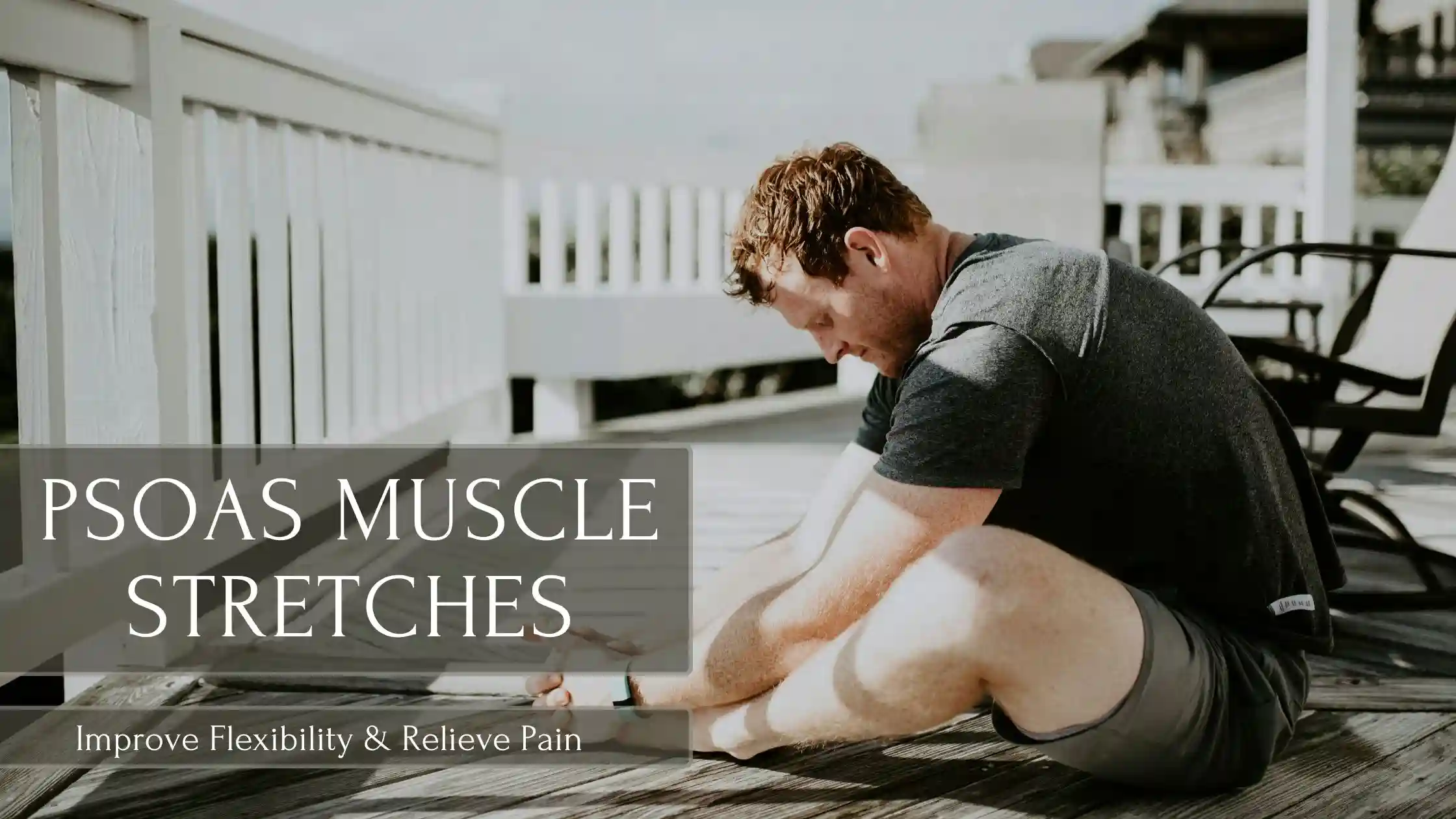

The psoas stretch is a half-kneeling hip-flexor stretch used to improve flexibility through the front of the hip and increase comfortable hip extension. The most important technique is not how far you push your hips forward—it is maintaining control of your pelvis and lower back while gradually moving into the stretch.
Although it is commonly called a “psoas stretch,” the movement does not perfectly isolate the psoas. It stretches the broader hip-flexor region, including the iliopsoas, with positioning determining where you feel the greatest tension.
For most people, a gentle posterior pelvic tilt—think of lightly tucking your tailbone—makes the movement more targeted and reduces the tendency to substitute lower-back arching for actual hip extension.
What Is the Psoas Muscle?
The psoas major is a deep muscle that begins along the lumbar spine and travels through the pelvis toward the upper femur. It works closely with the iliacus; together, these muscles are commonly referred to as the iliopsoas.
The iliopsoas is one of the body’s major hip flexors. It contributes to movements such as:
- Lifting the thigh toward the torso
- Walking and running
- Climbing stairs
- Moving from lying down toward sitting
- Controlling the relationship between the hips, pelvis, and lumbar spine
Because the psoas attaches to the lumbar spine, its anatomy is more complex than that of a muscle located entirely in the leg.
That is also why psoas stretching technique matters. Simply driving the hips forward while arching the back can create movement at the lumbar spine without producing the hip extension you are trying to achieve.
What Does a Psoas Stretch Actually Stretch?
A traditional half-kneeling psoas stretch primarily places the hip-flexor tissues of the rear leg into a lengthened position as the hip moves into extension.
It is better described as a psoas-emphasized hip-flexor stretch than a perfect psoas isolation exercise.
Several muscles can contribute to the sensation at the front of the hip, including:
- Psoas major
- Iliacus
- Rectus femoris
- Tensor fasciae latae and nearby tissues, depending on position
The exact tissue experiencing tension will vary with hip position, knee position, pelvic control, anatomy, and individual mobility.
You do not need to feel the stretch in one precise spot for the exercise to be useful.
How to Do a Half-Kneeling Psoas Stretch
The basic setup is simple, but small changes in pelvic position can substantially change the exercise.
Step 1: Start in Half-Kneeling
Place one knee on a padded surface and step the opposite foot forward.
Your front foot should be flat on the floor and stable.
The hip you want to stretch is on the side of the kneeling leg.
Step 2: Get Tall Before Moving Forward
Bring your torso upright rather than leaning forward over the front leg.
Think about stacking your rib cage approximately over your pelvis.
You should feel balanced enough that you do not have to strain to stay in position.
Step 3: Gently Tuck the Pelvis
Before pushing the hips forward, create a small posterior pelvic tilt.
A simple cue is:
“Bring your belt buckle slightly toward your ribs.”
You can also lightly squeeze the glute on the kneeling side.
The movement should be subtle. You do not need to aggressively flatten your lower back.
Step 4: Shift Forward Slowly
Keeping the pelvic position you just created, move your body forward slightly until you feel mild-to-moderate tension across the front of the hip on the kneeling side.
Do not chase maximum depth.
If your lower back begins to arch substantially, reduce the forward movement and reset your pelvis.
Step 5: Hold and Breathe
Take slow, normal breaths while maintaining the position.
A practical starting point is about 20–30 seconds.
If the position feels comfortable, repeat once or twice before switching sides.
Stretch duration is not a magic number. Consistency and appropriate intensity matter more than forcing a specific hold time.
The Most Important Form Cue: Control the Pelvis
Pelvic position is one of the most useful ways to improve this stretch.
In a traditional half-kneeling hip-flexor stretch, it is easy to create the appearance of greater range simply by tilting the pelvis forward and extending the lower back.
That compensation may allow you to travel farther forward without necessarily increasing useful hip extension.
A small clinical study comparing conventional half-kneeling hip extension with a version incorporating posterior pelvic tilt found that the pelvic-tilt variation produced a greater change in a measure of reactive hip-flexor force.
That does not prove that one technique is universally superior, but it supports what good coaching practice already suggests:
Control the pelvis first, then add hip extension.
A useful sequence is:
- Get tall.
- Lightly tuck the pelvis.
- Squeeze the rear-side glute gently.
- Move forward only as far as you can maintain that position.
Where Should You Feel a Psoas Stretch?
Most people feel tension somewhere around the front of the hip or upper thigh of the kneeling leg.
The sensation can differ substantially from person to person.
You should generally be looking for:
- Mild-to-moderate muscular tension
- A stretching sensation through the front of the hip
- A position you can breathe in normally
- No sharp pain
- No pinching deep in the front of the hip
You do not need to feel an extremely deep sensation inside your abdomen to prove that you are stretching your psoas.
Because the psoas is a deep muscle, it can be difficult to identify precisely by sensation alone.
Common Psoas Stretch Mistakes
Arching the Lower Back
This is probably the most important error.
If you push the hips forward by increasing lumbar extension, you may look as though you are moving farther without getting additional useful hip extension.
Fix: Reduce the range, gently tuck the pelvis, and then shift forward again.
Pushing Too Far Forward
A deeper lunge is not automatically a better psoas stretch.
Once your pelvic position is lost, additional forward motion may simply create compensation elsewhere.
Fix: Use the smallest amount of forward movement needed to feel moderate tension.
Leaning the Torso Forward
Leaning forward can make the position easier, but it also changes the hip angle and may reduce the front-of-hip stretch.
Fix: Keep the torso comfortably upright.
Forcing the Pelvic Tuck
Posterior pelvic tilt is useful, but more is not always better.
Aggressively contracting your abdomen or trying to flatten your spine completely can make the exercise unnecessarily uncomfortable.
Fix: Think “small tuck,” not maximum tuck.
Letting the Front Knee Collapse Inward
The front leg provides your base of support.
Fix: Keep the knee generally tracking in the same direction as the foot.
Ignoring Front-of-Hip Pinching
A stretch sensation and a joint-pinch sensation are not the same thing.
If moving farther forward produces sharp or pinching discomfort at the front of the hip, do not force through it.
What Are the Benefits of the Psoas Stretch?
The strongest reason to use the psoas stretch is straightforward: to work on hip-flexor flexibility and hip extension range of motion.
May Improve Hip Extension Mobility
Stretching research consistently shows that stretch training can improve joint range of motion over time.
For someone with limited hip-flexor flexibility, the half-kneeling position provides a simple way to work specifically on hip extension.
Gives You Direct Control Over Pelvic Position
Unlike some more complex stretches, the half-kneeling position makes it relatively easy to experiment with pelvic alignment.
That makes the exercise useful for learning the difference between:
- Hip extension
- Anterior pelvic tilt
- Posterior pelvic tilt
- Lumbar extension
That movement awareness can be as valuable as simply getting “deeper” into the stretch.
Can Fit Into a Broader Hip-Mobility Routine
The psoas stretch works well alongside movements that address other hip motions.
For example, rotational work such as 90-90 hip rotation addresses a different component of hip mobility.
That can produce a more complete mobility session than repeatedly stretching the hip flexors alone.
Does Sitting Make the Psoas Tight?
Sitting keeps the hips in flexion for long periods, so it is reasonable for people who sit extensively to feel stiff when they later move into hip extension.
However, the common statement that sitting automatically causes a permanently “shortened psoas” is too simplistic.
A feeling of tightness can reflect several factors, including:
- Time spent in one position
- Activity level
- Strength
- Stretch tolerance
- Joint mobility
- Training demands
- Previous injury
- Individual anatomy
If you spend much of the day sitting, a psoas or hip-flexor stretch can be one useful movement option.
But the broader solution is usually more varied movement, not simply stretching one muscle repeatedly.
Psoas Stretch vs. Kneeling Hip Flexor Stretch
These names are often used interchangeably because the movements can look almost identical.
The difference is mostly one of emphasis.
A kneeling hip flexor stretch targets the front-of-hip musculature broadly.
When that same position is performed with careful pelvic control and an emphasis on the iliopsoas region, it is commonly called a psoas stretch.
In practice, there is substantial overlap.
That is why you should not expect any half-kneeling position to isolate only one hip-flexor muscle.
Psoas Stretch vs. Low Lunge
The low lunge hip flexor stretch uses a similar split-stance position but generally allows more forward displacement and may include different torso or arm positions.
Choose the version that allows you to maintain the best control.
If you can stay upright and maintain pelvic position in a low lunge, the increased range may be useful.
If you compensate by arching the lower back, the simpler half-kneeling version is usually easier to control.
Psoas Stretch vs. Hip Flexor Wall Stretch
The hip flexor wall stretch changes the rear-leg position by placing the shin or foot against a wall.
That typically increases knee flexion, which can substantially increase tension through the rectus femoris in addition to other front-of-hip tissues.
For that reason, the wall variation is not necessarily a “better psoas stretch.”
It is a different hip-flexor stretch with a different emphasis.
Supported Psoas Stretch for Beginners
If balance makes the normal version difficult, place one hand on:
- A chair
- A wall
- A stable bench
- A sturdy rail
Removing the balance challenge can make it easier to focus on the pelvis and hips.
You can also place extra padding under the kneeling knee.
There is no benefit to tolerating knee discomfort just to perform the stretch on the floor.
How Intense Should a Psoas Stretch Be?
Aim for gentle to moderate tension rather than pain.
A good stretch should allow you to:
- Maintain the intended position
- Breathe normally
- Relax rather than brace aggressively
- Exit the position under control
More intensity is not automatically more effective.
Stop if you feel:
- Sharp pain
- Significant front-of-hip pinching
- Numbness
- Tingling
- Burning or electric sensations
- Pain traveling down the leg
- Dizziness
- A sudden worsening of existing symptoms
When Should You Avoid or Modify the Stretch?
A routine mobility stretch is not a substitute for evaluation of unexplained hip, groin, pelvic, or lower-back pain.
Consider professional guidance before stretching aggressively if you have:
- A recent hip or back injury
- Recent hip, pelvic, or abdominal surgery
- Significant joint instability
- Known hip pathology
- Severe or worsening pain
- Neurological symptoms
- Difficulty walking or bearing weight
- Symptoms you believe may be psoas syndrome
Psoas syndrome is relatively uncommon, and pain around the hip, groin, pelvis, or lower back can have many other causes.
Do not assume that pain in this region means your psoas is “tight” and simply needs to be stretched harder.
Can Assisted Stretching Target the Psoas?
An assisted-stretching practitioner can guide the leg and pelvis through hip-flexor stretching, which may make positioning easier for someone who struggles to control the stretch alone.
Potential advantages include:
- External stabilization
- Positioning assistance
- Controlled stretch intensity
- Feedback about compensation
- Ability to relax while someone else guides the movement
However, professional assistance does not change the anatomy: the practitioner is still working with a group of tissues around the hip rather than perfectly isolating one deep muscle.
If you are looking for professional stretching rather than self-directed exercises, the FlexologyGuide studio directory can help you explore assisted-stretching studios by location.
A Simple Hip-Mobility Sequence
The psoas stretch can be combined with movements that address different hip motions rather than repeatedly stretching the same region.
One simple sequence is:
- 90-90 hip rotation — controlled hip internal and external rotation
- Psoas stretch — hip extension with pelvic control
- Kneeling hip flexor stretch — general front-of-hip mobility
- Low lunge hip flexor stretch — optional progression
- Gentle walking or active hip movement afterward
You do not need every variation in every session.
Choose movements that address your actual mobility goals.
For a broader collection of flexibility and mobility exercises, visit the FlexologyGuide Stretching Hub.
Psoas Stretch FAQ
What is the best way to stretch the psoas?
A practical starting position is a half-kneeling hip-flexor stretch with the torso upright and a gentle posterior pelvic tilt. Maintain the pelvic position while shifting slightly forward until you feel moderate tension through the front of the rear hip.
How long should I hold a psoas stretch?
About 20–30 seconds is a reasonable starting point for many healthy adults. Hold only as long as you can maintain good positioning without pain. Longer is not automatically better.
How many times should I repeat the stretch?
One or two controlled repetitions per side can be enough for a short mobility session. Overall consistency across days and weeks matters more than accumulating a large number of repetitions in one session.
Where should I feel a psoas stretch?
Most people feel tension near the front of the hip or upper thigh on the kneeling side. You do not need to feel an intense deep-abdominal sensation to perform the stretch effectively.
Should I squeeze my glute during a psoas stretch?
A light contraction of the glute on the kneeling side can help control the pelvis and limit excessive anterior pelvic tilt. The contraction should support the position rather than become an intense strength exercise.
Should I tuck my pelvis during a psoas stretch?
A slight posterior pelvic tilt can help reduce compensation from the lower back and emphasize hip extension. Research comparing hip-flexor stretching techniques provides some support for incorporating pelvic control rather than simply pushing farther forward.
Can a psoas stretch help lower-back pain?
Some people with limited hip-flexor mobility may find stretching comfortable, but lower-back pain has many possible causes. A psoas stretch should not be considered a treatment for unexplained back pain.
Is a psoas stretch the same as a hip-flexor stretch?
A psoas stretch is a type of hip-flexor stretch. Because the psoas works with the iliacus and other muscles around the hip, the movement does not isolate the psoas completely.
Can I stretch my psoas every day?
Gentle mobility work can often be performed frequently if it remains comfortable and you recover well. You do not need aggressive daily stretching to make progress, and pain is a reason to modify or stop rather than push harder.
Why do I feel the stretch in my quad instead of my psoas?
Your position may be placing more tension on another hip-flexor muscle such as the rectus femoris. The sensation can also vary with individual anatomy. Try reducing the depth, controlling the pelvis, and keeping the rear knee in a comfortable position.
Related Resources
Kneeling Hip Flexor Stretch — Learn the general half-kneeling hip-flexor variation.
Low Lunge Hip Flexor Stretch — Progress the position through a larger lunge-based range.
Hip Flexor Wall Stretch — Explore a variation that changes rear-leg and quadriceps involvement.
90-90 Hip Rotation — Work on internal and external hip rotation.
Stretching Hub — Explore the broader FlexologyGuide stretching and mobility library.
Conclusion
The psoas stretch is most useful when you stop thinking about how far you can push forward and start paying attention to where the motion is coming from.
A controlled half-kneeling position, slight posterior pelvic tilt, upright torso, and gradual hip extension can make the stretch more focused while reducing compensation through the lower back.
It is also important to recognize that the exercise stretches a broader hip-flexor complex rather than isolating the psoas perfectly.
Use it as one tool within a balanced mobility program—not as a cure for every case of hip tightness, back discomfort, or posture-related concern.