

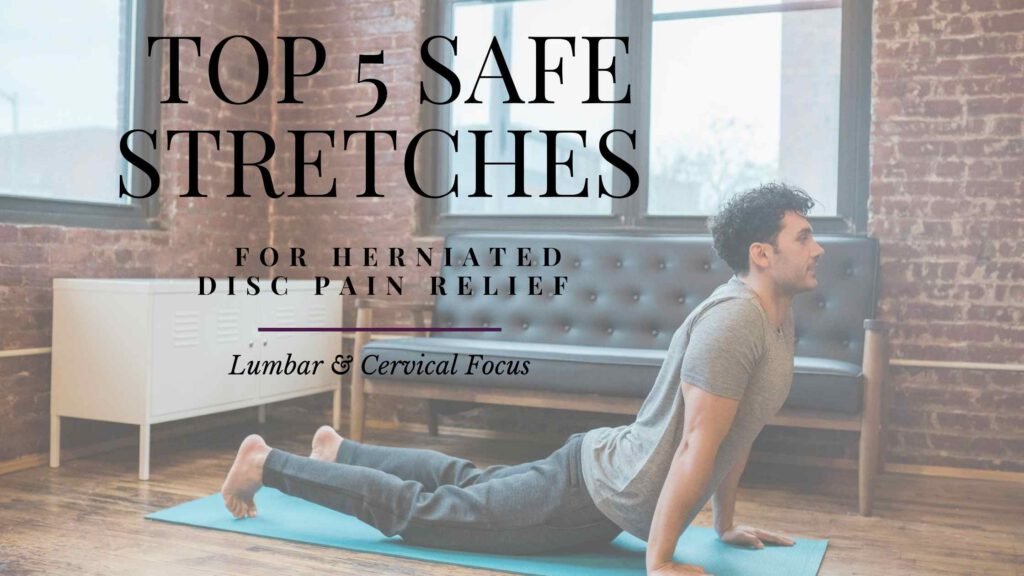
If you’re struggling with herniated disc pain—whether it’s lower back, neck, or mid-back—you might be dealing with nerve compression, stiffness, or radiating discomfort. Here are 5 Stretches for Herniated Disc. As a mobility coach with extensive experience guiding clients through disc issues, I’ve seen how the right stretching routine can help ease inflammation, improve spinal flexibility, and relieve pressure. While stretching alone doesn’t heal the disc, it’s a powerful tool to reduce flare-ups—when done safely and properly. Always get personalized advice from a healthcare provider before beginning any routine.
What Is a Herniated Disc?
A herniated disc (also called a slipped or ruptured disc) occurs when the soft inner material pushes through the outer fibrous ring—compressing nearby nerves. This can cause pain, numbness, or muscle weakness in the lower back, buttocks, arms, or legs, depending on the affected area. The lumbar (lower back) region is most common, though herniations can also happen in the cervical (neck) or thoracic (mid-back) spine.
Why Stretching Helps Herniated Disc Symptoms
Gentle stretching offers multiple benefits:
- Spinal decompression — relieves disc pressure
- Enhanced blood circulation — supports healing
- Reduced nerve strain — alleviates pain
- Muscle relaxation — eases tightness that pulls on the spine
Consistent, controlled stretching can reduce inflammation and prevent stiffening—just avoid jerky or aggressive moves that may worsen your condition.
Most Effective Stretches for Herniated Disc, Lower Back Stretches
1. Supported Child’s Pose
- Why it works: Gently lengthens and decompresses the lumbar spine
- How to do it:
- Kneel, big toes touching, knees wider than hips
- Sink your hips toward your heels, rest your torso on a pillow or block
- Breathe deeply for 30–60 seconds
2. Prone Press-Up (McKenzie Extension)
- Why it works: Helps re-center disc material, reducing nerve irritation
- How to do it:
- Lie face‑down, hands under shoulders
- Press up into a mild cobra—keep hips grounded
- Hold 10–15 seconds, repeat 5–10 times, stop before pain starts
3. Pelvic Tilt
- Why it works: Strengthens core muscles responsible for spinal support
- How to do it:
- Lie on your back, knees bent, feet flat
- Tighten abs, flatten lower back
- Hold 5–10 seconds, repeat 10 times
4. Modified Knee‑to‑Chest Stretch
- Why it works: Relieves tension in sciatic/gluteal area, reducing lumbar strain
- How to do it:
- Lie on your back, bring one knee to your chest
- Keep the other leg bent or straight—choose what feels best
- Hold 20–30 seconds, switch sides
5. Standing Hamstring Stretch
- Why it works: Releases hamstring tightness that can pull on your pelvis
- How to do it:
- Place heel on a low step or bench
- Keep your back flat, hinge from your hips
- Hold 20–30 seconds, avoid rounding your spine
Neck (Cervical) Stretches for Herniated Disc
1. Chin Tucks
- Sit or stand with neck aligned
- Pull chin straight in (like a double chin)
- Hold 5 seconds, repeat 10–15 times
2. Neck Side Bends (Gentle)
- Sit tall, gently drop your ear toward your shoulder
- Add light hand pressure for deeper release
- Hold 20 seconds, switch sides
These moves ease cervical nerve compression and restore neck mobility.
When to Stretch—and When to Stop
✅ Safe to stretch if:
- You experience only mild to moderate ache
- Movements don’t worsen symptoms
- Your provider has approved it
❌ Avoid stretching if:
- You have severe pain or new numbness
- Any stretch triggers sharp, radiating pain
- A medical evaluation hasn’t been completed
Pro tip: Warm up with gentle movement, breathe steadily, and don’t hold your breath.
Fast A 10‑Minute Daily Routine for Herniated Disc (Lumbar + Cervical)
- Prone Press‑Up – 5 reps
- Supported Child’s Pose – 60 sec
- Pelvic Tilt – 10 reps
- Modified Knee‑to‑Chest – 30 sec each side
- Standing Hamstring Stretch – 30 sec each side
- Chin Tucks (if applicable) – 10 reps
Practical, consistent, and easy to integrate into daily life—with noticeable mobility improvements week by week.
Assisted Stretching for Herniated Disc Relief
Assisted stretching can be a valuable complement to a self-guided stretching routine—especially if you’re dealing with a herniated disc in the lower back, neck, or mid-back. Unlike traditional stretching where you move yourself, assisted stretching is performed one-on-one with a trained professional who helps guide your body into safe, controlled positions while you remain relaxed.
Why assisted stretching can help with herniated disc symptoms
When disc issues are involved, precision matters. Assisted stretching focuses on:
-
Gentle spinal decompression to reduce pressure around irritated discs and nerves
-
Targeted muscle release in areas that commonly overcompensate, such as the hips, hamstrings, glutes, and upper traps
-
Improved joint mobility without forcing end-range positions that could worsen symptoms
-
Nervous system down-regulation, helping reduce muscle guarding and protective tension
Because the practitioner controls the depth, direction, and intensity, assisted stretching is often safer than trying to push yourself at home—especially during flare-ups.
How assisted stretching differs from physical therapy
Assisted stretching is not a replacement for physical therapy or medical treatment. Instead, it works best as a supportive recovery tool alongside your provider’s recommendations. Physical therapy focuses on rehabilitation, strengthening, and corrective exercise, while assisted stretching emphasizes:
-
Passive and active-assisted range of motion
-
Muscle lengthening without strain
-
Ongoing mobility maintenance once acute pain is under control
Many people with herniated discs use assisted stretching after physical therapy to stay mobile, reduce stiffness, and prevent setbacks.
What a safe assisted stretch session should include
For disc-related concerns, a quality assisted stretching session should prioritize:
-
Clear communication about pain, symptoms, and movement limits
-
Neutral spine positioning with gradual progressions
-
Avoidance of aggressive twisting, deep spinal flexion, or forced traction
-
Emphasis on surrounding structures (hips, hamstrings, thoracic spine, shoulders) rather than direct pressure on the spine
Studios such as StretchLab follow a one-on-one model where sessions are customized based on your body, injury history, and comfort level.
Who benefits most from assisted stretching
Assisted stretching may be especially helpful if you:
-
Feel unsure about stretching correctly on your own
-
Experience muscle tightness that keeps returning despite home routines
-
Are transitioning out of acute pain but still feel stiff or guarded
-
Sit for long hours and notice disc symptoms flare with inactivity
That said, always get clearance from your healthcare provider before starting assisted stretching—particularly if you’ve had recent imaging, injections, or worsening neurological symptoms.
Bottom line
When done thoughtfully, assisted stretching can help reduce tension, improve mobility, and support long-term comfort for people managing herniated disc symptoms. It doesn’t “fix” the disc—but by restoring movement and easing protective muscle tightness, it can make daily life far more manageable and help you stay consistent with your recovery plan.
FAQs on Stretching With a Herniated Disc
Q: Can stretching heal a herniated disc?
No—it doesn’t repair the disc structure, but it significantly reduces symptoms and supports recovery.
Q: Is daily stretching safe?
Yes, as long as it’s gentle and pain-free. Daily consistency is highly beneficial.
Q: Should I avoid forward bending?
Often—over-flexion can aggravate herniations, especially in the lumbar spine. Stick with neutral or extension-focused moves unless your provider advises otherwise.
Q: How soon will I feel relief?
Some people notice improvements within days, others take weeks. Healing timelines vary—be patient and steady.
Q: Are yoga poses safe for herniated discs?
Some are—Child’s Pose and mild back extensions like Sphinx are great. Deep forward bends or twists should be avoided unless supervised.
Final Takeaway
Strategic stretches can give you back control over herniated disc pain. From decompressing your spine to relaxing tight muscles, this smart approach—combined with medical guidance—supports recovery and builds mobility. With consistency and care, you can step into a pain-reduced daily life.