

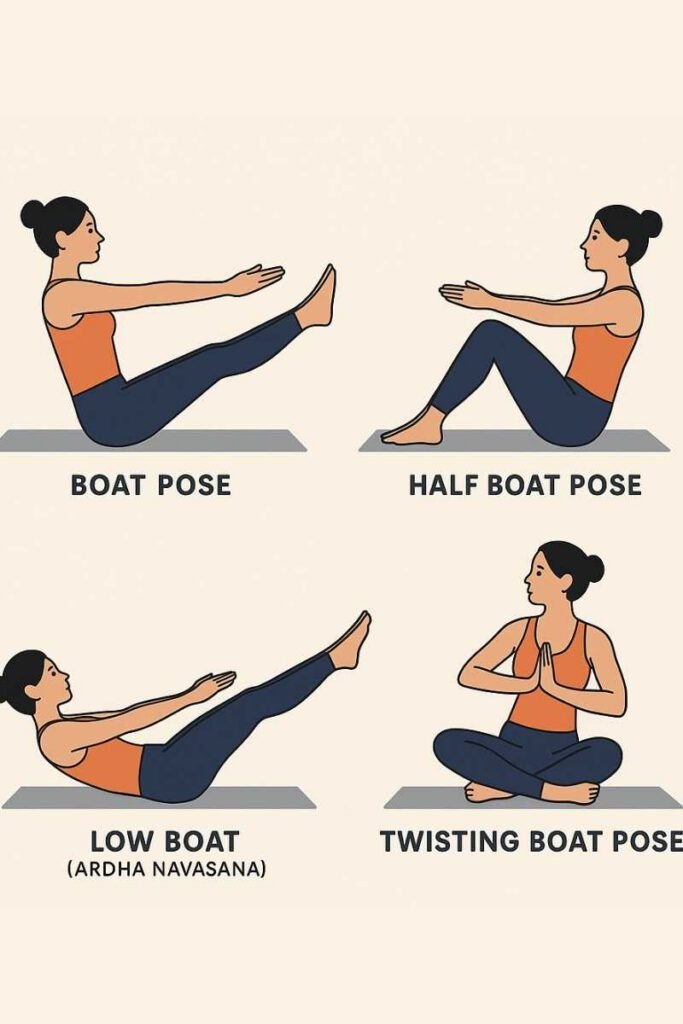

Boat Pose and its variations—Half Boat, Low Boat (Ardha Navasana), and Twisting Boat—aren’t just yoga staples. They’re transformative tools for building core strength, balance, posture, and mind-body connection. Perfectly adaptable, these poses scale with your progress, helping you:
- Forge deep core endurance
- Enhance spinal alignment and posture
- Boost concentration through breath control
Let’s dive into each pose, how to do it safely, and key benefits—and common mistakes to avoid.
Full Boat Pose (Paripurna Navasana)

What it is:
A seated “V” position balancing on your sit bones, with legs lifted and spine long.
How to do it:
- Sit with knees bent, feet flat.
- Lean back slightly, lengthen your spine.
- Lift shins parallel to the floor (modify here).
- Straighten legs to form a “V.”
- Reach arms forward at shoulder height.
- Hold, breathing steadily, for 20–60 seconds.
Benefits:
- Builds full-core strength (including hip flexors, quads, and low-back)
- Improves posture and balance
- Cultivates breath awareness and focus
Common pitfalls:
- Collapsing the chest → Keep the spine tall
- Holding breath → Inhale to lift, exhale to engage
Half Boat Pose
What it is:
A foundational variation easing into the full Boat.
How to do it:
- From seated, lean back slightly.
- Keep knees bent, shins parallel.
- Extend arms forward, engage the core.
- Hold for 30–60 seconds, breathing evenly.
Why it helps:
- Accessible for beginners stronger alignment control
- Eases lower-back pressure
- Builds endurance before advancing
Low Boat Pose (Ardha Navasana)
What it is:
A deeper core challenge—shoulders and legs hover just above the mat.
How to do it:
- Begin seated, then lie back.
- Lift shoulders, upper back, and legs off mat.
- Lower legs inches above the mat—low back stays grounded.
- Arms parallel to floor or overhead.
- Hold 15–30 seconds.
Benefits:
- Activates deep transverse abdominis
- Strengthens hip flexors under load
- Reinforces mindful breathing under tension
Avoid:
- Letting the lower back arch → Keep it firm on your mat
Twisting Boat Pose

What it is:
A dynamic core twist that targets obliques and improves spinal flexibility.
How to do it:
- Start in Half or Full Boat.
- Bring hands to prayer at the chest.
- Inhale to lengthen, exhale twist elbow toward opposite knee.
- Return to center, switch sides.
- Repeat 5–10 twists per side.
Benefits:
- Builds stronger obliques
- Enhances rotational mobility
- Fosters coordination and balance in motion
Pose Breakdown At-a-Glance
| Pose | Level | Muscles Targeted | Why Use It |
| Full Boat Pose | Intermediate | Core, hip flexors, quads, low-back | Stability, posture, full‑core activation |
| Half Boat Pose | Beginner | Core, hip flexors | Safer entry point, mental focus |
| Low Boat (Ardha Navasana) | Advanced | Deep core, hip flexors | Intense engagement, strengthening transitions |
| Twisting Boat Pose | Intermediate | Obliques, transverse abdominis | Rotational strength, balance in motion |
Tips for Success & Progress
- Mind your breath. Don’t hold it—inhale to lift, exhale to stabilize.
- Prioritize alignment. Keep the spine tall, chest open.
- Modify smartly. Use blocks under the feet, or hold knees until you build strength.
- Be consistent. Even 1–2 holds a day boosts core stability over time.
FAQs
Q: My legs won’t straighten—what now?
A: No problem—stick with bent knees in Half Boat and gradually work toward full extension as you build strength.
Q: Could Low Boat damage my lower back?
A: Only if you lose lower‑back connection to the mat. Keep that contact, or stay with higher leg lifts until you’re strong enough.
Q: How often should I practice?
A: Daily consistency is effective—1–2 sets of 30–60 seconds per variation support steady progress.
Q: Will Boat Pose help with belly fat?
A: While it won’t melt fat on its own, it builds foundational core strength that complements calorie burn in an overall fitness routine.
Q: What’s the difference between Boat Pose and V‑ups?
A: Boat Pose is a static hold targeting core endurance, while V‑ups are dynamic movements—both effective, but each serves different goals.
Final Thoughts
Boat Pose and its variations are cornerstones of a resilient, balanced core practice—whether you’re new or experienced. Start with Half Boat, progress through Full and Low, then introduce twists. Commit, breathe deeply, and tune into your body—your strength and confidence will follow.